Kajol is back on the big screen, and that’s always… an experience. She has this knack for commanding attention—loud, brash, occasionally abrasive—but undeniably watchable. Even if you don’t always love the way she plays her characters, you end up glued to her performance because she brings a certain intensity that refuses to be ignored.
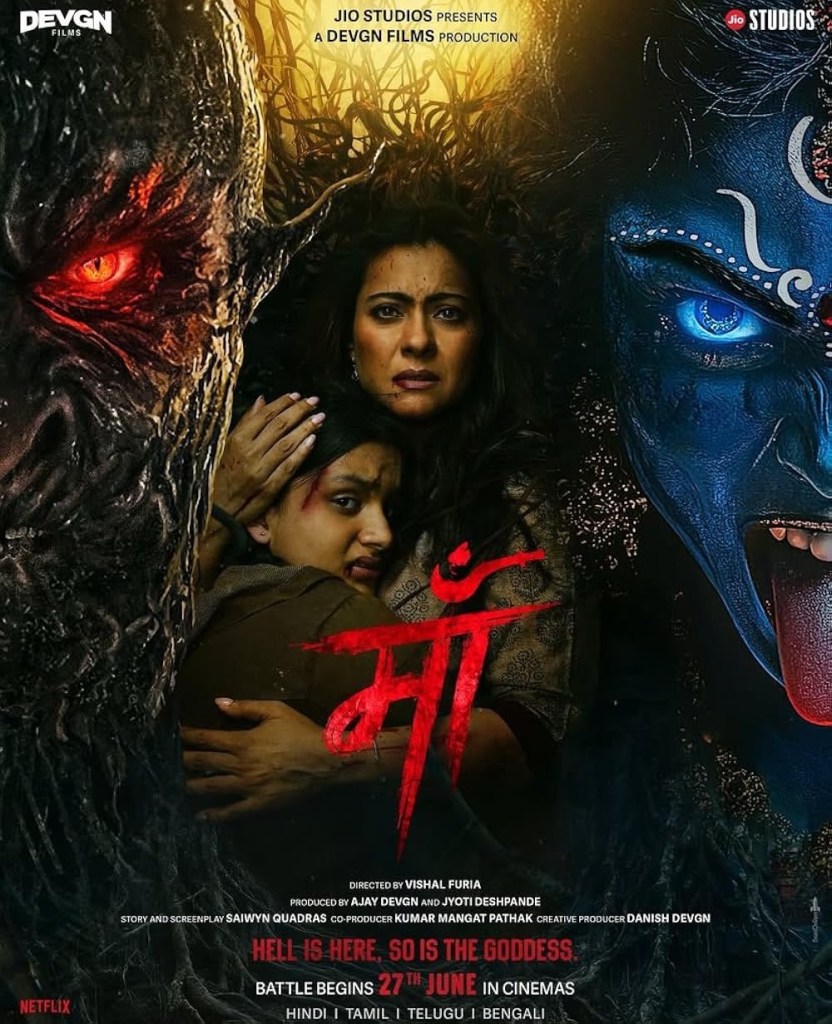
In Maa, she plays mother to a young daughter, married to a man who’s long since cut ties with his family and their “cursed” village. The curse, as the legend goes, demands every girl child as a sacrifice to a demon. Subtle? Not really. Understandably, Kajol’s husband has chosen to live far, far away in a nuclear setup. But duty calls when his father dies, and he heads back to the village—only to wind up dead himself. (Not much of a spoiler, the movie telegraphs it from miles away.)
Kajol, now widowed and left to deal with the ancestral home that’s being sold, is pulled back into the village and its messy, sinister folklore. From there, things unravel fast: daughters behaving strangely, one girl vanishing only to reappear mysteriously, and an atmosphere thick with dread. The village revolves around Durga Puja, with a locked temple of Durga Maa that only opens when someone dreams of Kali Maa. Of course, that dream lands on Kajol’s shoulders, because who else is going to save the day?
The plot leans heavily on familiar horror tropes—creepy children, family secrets, sudden vanishings—but spices it with a mythological angle. There are definitely gripping moments where you sit up straighter, but just as often, the tension fizzles out thanks to clunky dialogue or horror beats that feel a little too reheated. It’s engaging enough to keep you watching, but not groundbreaking.
As for performances: Kajol holds the film together, though not flawlessly. Her larger-than-life style sometimes works, sometimes overwhelms, but she gives the role conviction. The husband, for the brief time he’s alive, plays his estranged-son act decently before being written out. The daughter has her moments of wide-eyed terror, and the villagers do their job of looking suitably haunted by both demons and family politics.
Ronit Roy plays the elder in the family, but the way his character is written and staged robs the arc of real suspense. From early on, it feels fairly obvious where his character is headed. That said, Roy still brings weight to the role—his restrained menace, the slow hardening of his presence, and the way he carries himself gives the character some bite. Even if the twist isn’t suspenseful, his performance is fairly decent.
The emotional beats hit hard at times—loss, motherhood, the weight of tradition—but they’re also laid on thick. The film wants to be about good versus evil, faith versus fear, but it can’t always decide whether it’s horror, family drama, or mythological thriller. The result is uneven: moments of suspense followed by stretches of melodrama that drag.
So, is it worth watching? Once, yes. It’s not among Kajol’s strongest outings, but she’s compelling enough to make it serviceable. The movie is gripping in parts, flawed in many, and ultimately lands in that murky middle ground of “watchable but not memorable.”
Final Word: Maa is a one-time watch—part horror, part mythology, part melodrama, with Kajol powering through a shaky script. It’s neither a disaster nor a masterpiece, but it’s got enough to keep you from turning it off halfway.
 Honest Reviews