There are two reasons to press play on After the Hunt, currently sitting on Amazon Prime like a moody cat that may or may not scratch you: Julia Roberts and Andrew Garfield. Honestly, that should be enough. These are stalwarts. Icons. Eyebrow-raising, smile-flashing, megawatt sensations who usually guarantee at least a popcorn-worthy evening. But somewhere between expectations and execution, this film left me wondering whether I needed a Yale degree to fully “get it” — preferably in philosophy, like Julia Roberts’ character. Because clearly I, a mere mortal, may not have the intellectual bandwidth required.
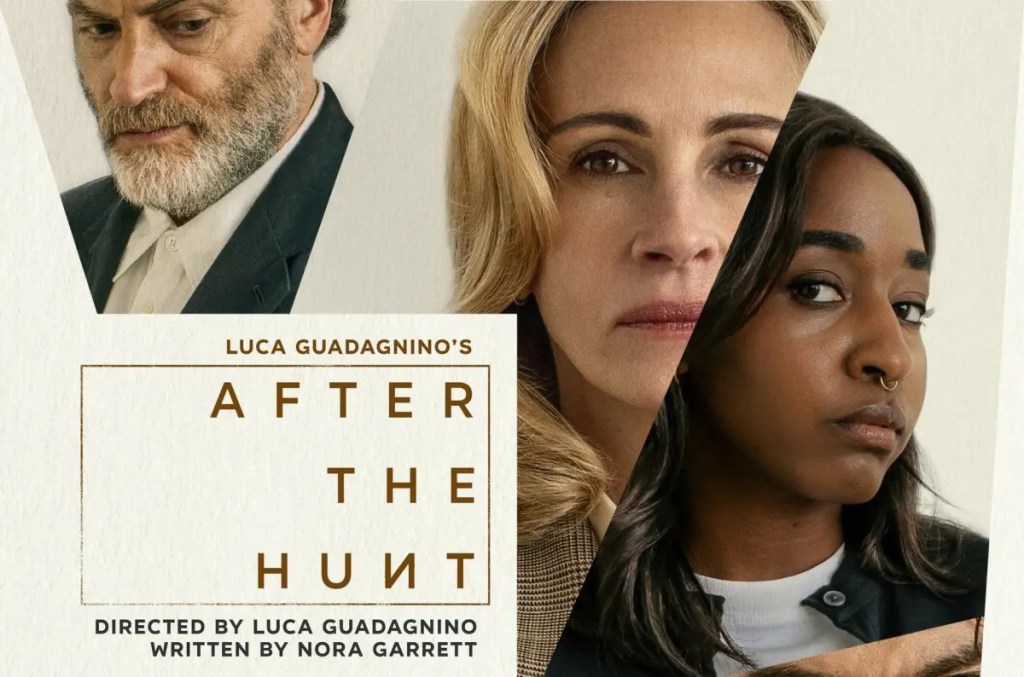
The premise is deceptively simple: Roberts plays a Yale philosophy professor whose colleague and friend, Hank, finds himself accused of sexually assaulting a young African-American woman. What follows is a psychological drama—thriller? academic morality maze? intellectual sudoku puzzle?—where you’re basically squinting at the screen for two hours going, “Wait—what?” And not in the good twisty thriller way. More in the “I thought this was going somewhere but maybe it isn’t… or maybe it is… or maybe I’m just dumb?” way.
In fairness, the movie tries to do that clever thing where it keeps you guessing about who’s lying, who’s telling the truth, and who desperately needs a therapist. It succeeds… for the most part. Right until the end, you’re doing your best impression of a confused houseplant, trying to find the sun. The film does eventually give you a bit of a peek into Hank’s true nature—but not enough to stop you from doing your own internal PhD thesis titled What Even Happened?.

Now, did I like the movie? Eh. Not particularly. It wasn’t terrible, but it wasn’t exactly the cinematic equivalent of a warm chocolate chip cookie either. It falls somewhere in the middle—mediocre, if you will. (Incidentally, the word “mediocre” is tossed around in the movie with enough regularity to make it feel like a drinking game waiting to happen.)
My real heartbreak, though, is Julia Roberts. She does the best she can with the role—but I kept wishing she’d land a film that truly lets her bite into something substantial. Something juicy. Something that lets her unleash the full Julia Roberts-ness of Julia Roberts, instead of being politely brilliant in a story that’s… fine. Just fine. Why Hollywood isn’t giving her absolute chef’s-kiss roles anymore is a question I demand answered.

To its credit, the film tries to address a whole buffet of themes: generational entitlement, the shifting dynamics between students and professors, the pressure of mentorship, the evolving definition of inappropriate behavior, and the generational gap between what was “normal” then and what is absolutely not normal now. There’s something clever buried in there—something sharp and introspective about power, ethics, and academic self-righteousness—but the storytelling sometimes feels like it’s trying too hard to be profound. It’s like that friend who uses words like “dialectical” in casual conversation: impressive, but exhausting.
All in all, After the Hunt is… good-ish. Not bad, not brilliant, not unwatchable, not unforgettable. It exists in that complicated space where you know the film is doing something meaningful, but you’re not entirely sure what, and you’re not fully convinced you care enough to rewind and figure it out.

Maybe I’m not as intellectual as the film wanted me to be. Maybe After the Hunt is a subtle masterpiece that sailed right over my head, leaving me waving at it from below like, “Hello? Wait? Was I supposed to think harder?” But honestly, sometimes a movie can simply be okay. And this one, for me, was okay—polished, well-acted, and thematically ambitious… but ultimately, just okay.
If you’re in the mood for something brainy and slow-burn with a sprinkle of academia, a dash of mystery, and Julia Roberts looking fabulous while carrying moral weight on her shoulders, give it a try. Just don’t blame me if you finish the movie slightly more confused than when you started.
 Honest Reviews