Well, The Holdovers is one of those films you click on when you’re feeling adventurous but not in the mood to risk two hours of your life on a Marvel sequel.

You start it with the emotional distance of a person watching someone else assemble IKEA furniture. And then—somehow, somewhere—you’re sucked in. Against your better judgement. Like a cat deciding it will sit in that cardboard box after all.
At first glance, the movie seems engineered for an all-boys boarding school alumni WhatsApp group—full of adolescent chaos, petty rebellions, and the unmistakable aroma of teenage overconfidence. But stick with it, and suddenly you find yourself empathising with every single character. Even the annoying ones. Even the professor. Especially the professor, actually, because he looks like the human embodiment of “I didn’t sign up for this”.
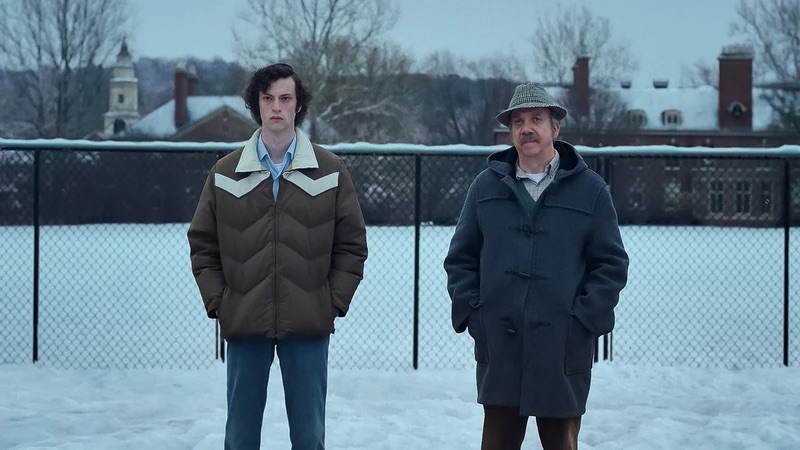
We meet this rule-loving, regulation-worshipping academic who is so by-the-book he might as well be the book. He’s the sort of man who probably irons socks and believes fun is a controlled substance. And then—cruelly, comically—he gets trapped at school during Christmas break with a group of boys who view rules the way cats view boundaries: purely decorative.
There are four or five of them—each with their own emotional baggage, tics, quirks, and an unfiltered belief that adults don’t actually feel feelings. Soon enough, the herd thins when the others get taken on vacation by one of the dads. And we’re left with just one boy and one professor, circling each other like two disgruntled planets forced into the same orbit.
What follows is not exactly a coming-of-age film—more like a coming-to-tolerate-each-other film. A slow-burn bromance between two wildly mismatched humans: one middle aged, crusty, and allergic to joy; the other young, troubled, and allergic to authority.
And in the middle of this emotional tug-of-war stands Mary — the only adult in the room who isn’t catastrophically emotionally stunted. But we’ll get to her.

But as Christmas works its magical Stockholm Syndrome, they begin to actually understand one another. The professor unclenches. The boy develops empathy. And unexpectedly, they both become… nice. Almost friends. It’s all very heart-warming in a “men discovering emotions like archaeologists dusting fossils” sort of way.
And then comes the ending—when our dear professor, stiff as a starched collar until now, does something utterly uncharacteristic. Something noble. Something self-sacrificial. The sort of thing that makes you sit up and whisper, “Okay… sir did WHAT now?” He takes one for the team. For the boy. And it’s probably the most human thing he’s ever done.
Yet behind all that tweed and simmering annoyance is a man bruised by life in quiet, devastating ways. When he finally softens, it’s like watching a glacier crack — rare, seismic, utterly worth the wait.
Paul Giamatti plays the professor like a man who is clinically allergic to joy, spontaneous behaviour, and possibly Christmas decorations. It’s a performance so perfectly irritable it feels artisanal — hand-crafted, slow-brewed, matured in oak barrels.
Angus Tully, played by Dominic Sessa is a teenage hurricane wrapped in sarcasm, loneliness, and a school uniform. Dominic Sessa’s performance is startlingly good — sharp on the outside, bruised on the inside, like a fruit you’re not sure whether to cut, peel, or throw.
He wants to appear invincible but leaks vulnerability every time he looks away. Watching him thaw — slowly, stubbornly — is real emotional theatre. And by the end, he becomes the bruised little core around which the whole story quietly rotates.
Mary is the emotional thermostat of the film — steady, warm, and painfully human. She carries her grief like a weight nobody helped her lift, and Da’Vine Joy Randolph plays her with a dignity that anchors every chaotic boy in the building.
She delivers wisdom without pretension, humour without theatrics, and comfort without ceremony. Every time she’s on screen, the film stops posturing and starts breathing. She doesn’t just steal scenes — she strolls in, pockets them, and walks off without apology.

In the end, The Holdovers isn’t flashy. It isn’t trying to reinvent cinema. It’s just a genuinely sweet, slightly scruffy story about intergenerational male bonding—not in the cheesy Hollywood sense, but in the very normal, very awkward, deeply human sense. Two people who shouldn’t get along… somehow do. And by the time the credits roll, you’re rooting for both of them like a proud parent at a school play.
A good watch. A gentle watch. A warm watch. And yes—catch it before it disappears from Netflix like your favourite snack you swore you left in the fridge.
 Honest Reviews