What happens when a beauty startup tries to highlight workplace stress with a marketing stunt that hits too close to home? You get YesMadam’s mass layoff-that-never-was debacle. Buckle up, because this story has all the makings of a wild Netflix drama: shocking twists, a PR nightmare, and a whole lot of “what were they thinking?”
Let’s break it down.
Who Is YesMadam?
First, a little background on our protagonist: YesMadam. If you’re imagining a posh butler with a towel draped over his arm, let’s set the record straight. YesMadam is an Indian beauty and wellness startup that launched in 2016. Think beauty-on-demand. They offer a wide range of at-home salon services—from facials to massages—all booked through their app or website. Basically, they’re here to bring the spa experience to your living room while saving you the hassle of battling traffic or bad salon lighting.
The brand has grown steadily in the competitive beauty tech industry, carving out a niche as a customer-focused, convenience-driven service. But, as you’ll soon see, their recent marketing stunt has made them infamous for more than just glowing skin treatments.
The Controversial Marketing Stunt
Imagine you’re an employee at YesMadam. You’re sipping your morning chai, scrolling through emails, when BAM—you get an official notice saying you’ve been laid off. No warning, no “it’s not you, it’s us,” just a cold, corporate “you’re out.”
This wasn’t a drill. Well, actually, it was.
In an effort to highlight workplace stress (yes, really), YesMadam sent fake layoff emails to employees who had previously indicated in a company survey that they were feeling stressed. The survey itself was pitched as a workplace wellness initiative—a way for the company to understand their employees better. So, naturally, those who answered honestly were greeted with the news that they were fired. How’s that for solving workplace stress?
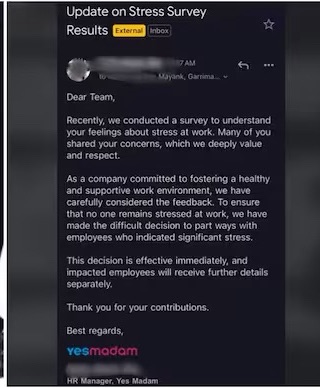
And here’s the kicker: the stunt went public. Screenshots of the emails began circulating on social media faster than you can say “PR nightmare.”
The Effect of the Stunt
The internet, as you might guess, went absolutely ballistic.
Employees: Some were understandably furious, feeling betrayed by a company they trusted. Others were confused—was this real? Was it a joke? Was this some kind of stress test designed by a sadistic HR team?
Social Media: The public reaction was swift and brutal. Twitter erupted with hashtags like #YesMadamNoThankYou and #FiredByEmail. Memes followed shortly after, with people jokingly updating their LinkedIn bios to “Fake layoff survivor at YesMadam.”
Media Coverage: The stunt made headlines across major outlets, turning a niche beauty brand into a household name for all the wrong reasons. Articles lambasted the company for its “insensitive” approach to addressing mental health, with some even calling for boycotts.
Why Did They Do It?
Believe it or not, there was a reason behind the madness.
According to YesMadam’s CEO, Mayank Arya, the stunt was designed to raise awareness about workplace stress and mental health. The idea was to start a conversation about how job insecurity contributes to anxiety and stress in modern workplaces. In theory, it was meant to be a thought-provoking campaign that sparked dialogue.
Arya later clarified that employees were informed in advance that this was part of a campaign. However, that little detail seems to have gotten lost in the execution—or conveniently omitted when the emails went viral.
In an apology statement, the company admitted they had underestimated how their “awareness campaign” would be received. Because, you know, nothing says “we care about your mental health” like pretending to fire you.
The Consequences of the Stunt
When you play with fire, you’re going to get burned. Here’s how the stunt backfired for YesMadam:
1. Loss of Trust
For employees, this was a massive breach of trust. Even if the layoffs weren’t real, the emotional toll was. Who wants to work for a company that thinks your mental health is fair game for a social experiment?
2. Negative Publicity
While the stunt did achieve one goal—getting people to talk about YesMadam—it did so at the expense of their reputation. Instead of being seen as an innovative beauty startup, they’re now the poster child for what NOT to do in marketing.
3. Customer Backlash
Many customers vowed to stop using YesMadam’s services, arguing that a company so tone-deaf about employee wellbeing couldn’t possibly care about its customers either. Some even left scathing reviews on Google Play and App Store, further damaging the brand’s image.
4. Industry Criticism
Marketing and HR professionals were quick to condemn the stunt as an irresponsible and unethical attempt at gaining attention. It became a cautionary tale in boardrooms across the globe.
Key Takeaways
So, what can we learn from this fiasco?
1. Sensitivity Matters
When dealing with serious issues like mental health and job insecurity, sensitivity is key. A campaign designed to address workplace stress should never cause more stress.
2. Communication Is Crucial
If employees were truly informed about the stunt in advance, that message clearly didn’t reach everyone. Clear and consistent communication could have mitigated some of the backlash.
3. Know Your Audience
What works as a provocative idea in a brainstorming session doesn’t always translate well in the real world. Always consider how your target audience (and your employees) will perceive your campaign.
4. Social Media Is a Double-Edged Sword
YesMadam probably hoped this stunt would go viral for being bold and innovative. Instead, it went viral for being insensitive and cruel. The internet has no mercy, and companies need to tread carefully.
5. Think Long-Term
Sure, this stunt got people talking, but at what cost? A short-term spike in attention isn’t worth long-term damage to your brand’s reputation.
Conclusion
YesMadam’s controversial marketing stunt is a textbook example of how good intentions can go horribly wrong when poorly executed. While the company aimed to spark a conversation about workplace stress, they ended up becoming the topic of a very different conversation—one about tone-deafness and bad PR.
The incident serves as a cautionary tale for brands everywhere: in the quest for virality, don’t lose sight of empathy and common sense. Because at the end of the day, no amount of publicity is worth alienating your employees, customers, and the internet.
So, next time you think about pulling off an “edgy” marketing campaign, just ask yourself: “Is this something YesMadam would do?” If the answer is yes, you might want to reconsider.
 Honest Reviews