Welcome to the ultimate showdown of digital shopping: Social Commerce vs. E-Commerce. In one corner, we have E-Commerce, the OG of online shopping—home to big-name retailers and checkout pages that sometimes ask for your great-grandmother’s maiden name before letting you buy a T-shirt.
In the other corner, we have the flashy, young, and dynamic Social Commerce, where influencers sweet-talk you into adding things to your cart while you’re just trying to mindlessly scroll through memes.
So, which one is winning? Which one is better for brands? And which one is more dangerous for your bank account (spoiler alert: both)?
Let’s dive in, dissect, and make this a shopping smackdown for the ages.
What is Social Commerce?
Picture this: You’re scrolling through Instagram, and boom—your favorite influencer is rocking a pair of sneakers that look too good to ignore. Before you know it, you tap “Shop Now,” check out without leaving the app, and five to seven business days later, those sneakers are on your feet. That’s social commerce.
Social commerce is shopping without leaving social media. It’s the evolution of window shopping, but instead of a mall, your “window” is your phone screen.
Where Does Social Commerce Happen?
• Instagram Shops – Where influencers sell products faster than you can double-tap.
• TikTok Shop – Where viral trends make you buy a heated eyelash curler you never knew you needed.
• Facebook Marketplace – Where you can find anything from handmade jewelry to a literal pet goat.
• Pinterest Shopping – Where everything looks aesthetic and makes you believe you need a new lifestyle.
• WeChat, Douyin (China’s TikTok), Xiaohongshu (Little Red Book) – The places where China is absolutely crushing social commerce.
The golden rule of social commerce? The less time a buyer has to think, the more likely they are to purchase. No second thoughts. No abandoned carts. Just instant gratification.
What is E-Commerce?
Now, let’s talk about E-Commerce—the OG king of online shopping.
E-Commerce is when you buy stuff from a brand’s website, an online marketplace, or an app. It’s a standalone experience, separate from your social media distractions (unless you have 50 tabs open, which, let’s be honest, you do).
Where Does E-Commerce Happen?
• Amazon – The land where you search for batteries and leave with an inflatable pool.
• Shopify-powered brand websites – Where DTC (Direct-To-Consumer) brands thrive.
• eBay – Where nostalgia meets insane bidding wars.
• Walmart.com, Target.com, BestBuy.com – Big retailers flexing their online muscle.
• Etsy – The paradise of handmade everything (and quirky, overpriced mugs).
E-Commerce boomed during the pandemic and became the preferred way to shop for literally anything. But social commerce is creeping up, ready to steal the crown.
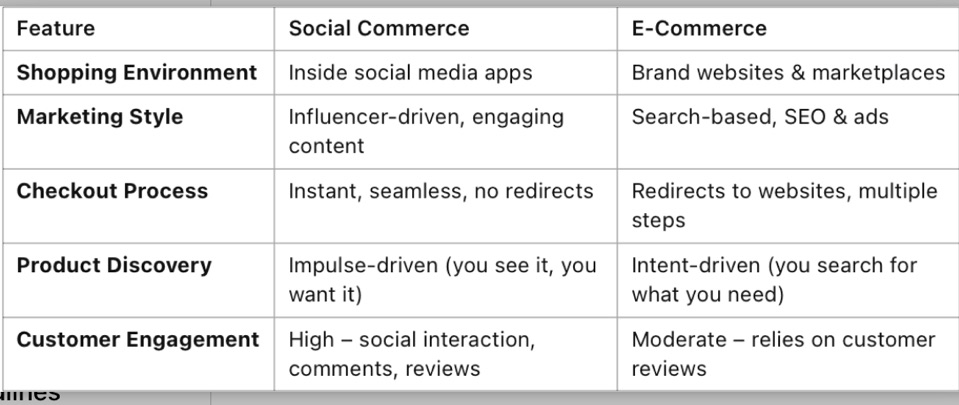
Social Commerce vs. E-Commerce: The Key Differences
Case Studies: Brands Winning at Social Commerce
Global Success Stories
1. SHEIN – The Fast Fashion Social Commerce Giant
• SHEIN has cracked the code on TikTok and Instagram by leveraging influencers and viral trends.
• Their TikTok hauls generate millions of views, and guess what? People buy in bulk.
2. Kylie Cosmetics – Instagram’s Beauty Empire
• Kylie Jenner turned her Instagram into a shopping platform.
• Instagram Stories + Shopping Links = Millions in sales without leaving the app.
3. Douyin (China’s TikTok) – A Billion-Dollar Social Commerce Machine
• In 2023, Douyin users spent over $200 billion on in-app purchases.
• Livestream shopping is huge in China—people buy from influencers live, in real-time.
Local Success Stories
1. Meesho (India) – The Social Commerce Revolution
• India’s largest social commerce platform where resellers sell products via WhatsApp, Instagram, and Facebook.
• Targeting small businesses, Meesho democratized social selling.
2. Nykaa (India) – Beauty Meets Social Commerce
• Started as an e-commerce beauty platform but now leverages influencers on Instagram and YouTube for social commerce domination.
Case Studies: Brands Crushing E-Commerce
Global Leaders
1. Amazon – The Undisputed King of E-Commerce
• The “one-click buy” experience has redefined convenience.
• Whether it’s groceries or gadgets, Amazon’s global presence is untouchable.
2. Nike – The Power of DTC E-Commerce
• Nike’s website and app allow for customization, membership perks, and exclusive drops.
• A case study in brand-owned e-commerce success.
Local Champions
1. Flipkart (India) – The E-Commerce Giant
• Competes head-to-head with Amazon in India.
• Big Billion Days Sale? Absolute madness.
2. Ajio (India) – The Fashion Powerhouse
• Reliance-backed Ajio has carved a niche in online fashion.
• Their strong e-commerce infrastructure is giving Myntra a run for its money.
Pros & Cons: Social Commerce vs. E-Commerce
Social Commerce Pros
✅ Seamless checkout experience – Fewer steps = more impulse buys.
✅ High engagement – Comments, likes, and shares = better reach.
✅ Trust-building via influencers – Feels like a friend’s recommendation.
Social Commerce Cons
❌ Over-reliance on social media algorithms – If your reach drops, so do your sales.
❌ Impulse buying risk – Customers might regret purchases.
❌ Limited control – Brands depend on platform policies and changes.
E-Commerce Pros
✅ Full brand control – Own your site, your rules.
✅ Better data insights – First-party data helps with better marketing.
✅ Scalability – Brands can expand globally with structured growth.
E-Commerce Cons
❌ More friction in checkout – Redirects = higher abandoned carts.
❌ Marketing expenses – SEO, ads, and PPC can be expensive.
❌ Less organic discovery – Customers must search for you.
Key Takeaways & Conclusion
1. Social commerce = impulse-driven, influencer-powered, and viral. It’s great for discovery and fast conversions.
2. E-commerce = structured, brand-controlled, and intentional. It’s ideal for customer retention and long-term brand building.
3. A hybrid approach works best. Brands should leverage social commerce for discovery and e-commerce for deeper engagement.
4. If you’re not selling on social media yet, you’re missing out. The future of shopping is social, mobile, and seamless.
So, what’s your take? Are you team Social Commerce (impulsive, instant, and influencer-driven)? Or are you loyal to E-Commerce (structured, strategic, and search-driven)?
Either way, your wallet is definitely going to feel the impact.
 Honest Reviews