If ambition had a background score, Matka King would be playing it on loop—loud, slightly chaotic, and impossible to ignore.
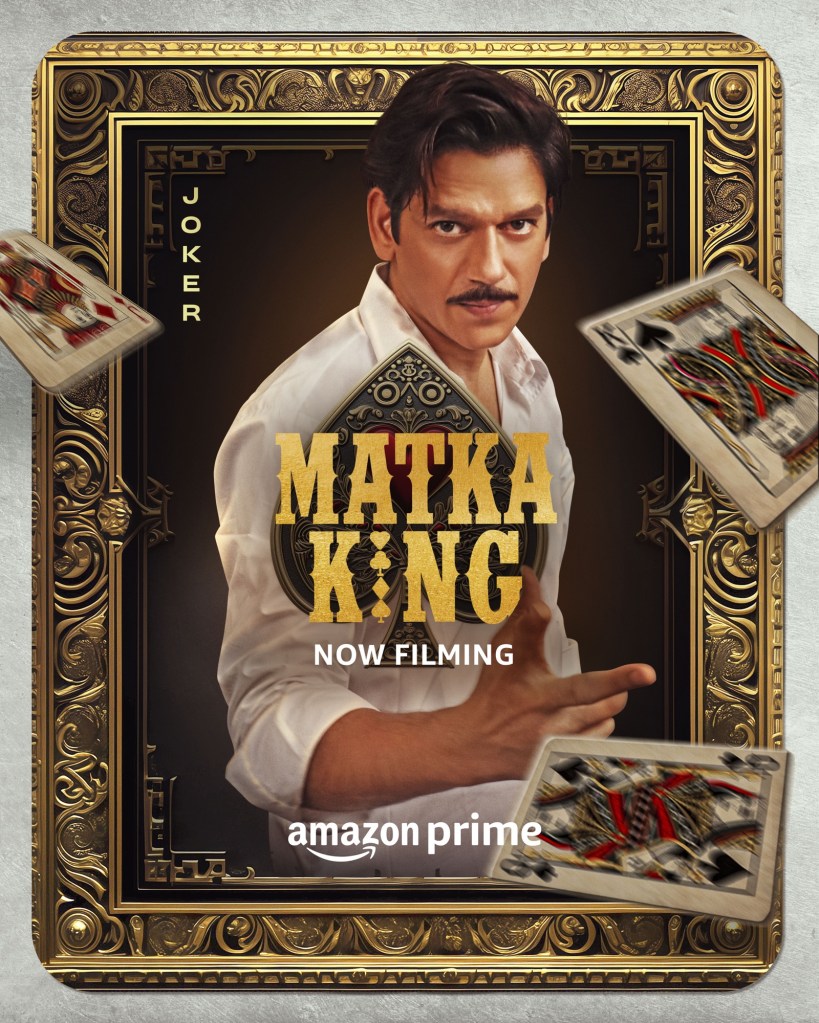
Streaming on Amazon Prime Video, Matka King dives into the murky, number-driven underbelly of Mumbai’s gambling scene, loosely inspired by the real-life figure Ratan Khatri. But don’t walk in expecting a clean biopic. This one’s more “inspired by true events” than “faithful retelling,” and honestly, it leans into that ambiguity like a seasoned gambler doubling down on a risky bet.
At the center of this whirlwind is Brij Bhatti played by Vijay Varma—an actor so effortlessly compelling that even when the plot stumbles, you’re still glued to him like a moth to a morally confused flame. He plays a man who seems to start off with principles, or at least the idea of them. There’s a lot of talk about honesty—so much, in fact, that you begin to think you’ve accidentally tuned into a TED Talk on ethics. But just when you’re nodding along, convinced of his moral compass, the show pulls the rug out from under you.
Suddenly, the man who positioned himself as the anti-corruption crusader of the Matka world starts looking suspiciously like… well, the very thing he claimed to oppose.
Now, is this intentional? Are we witnessing a nuanced exploration of moral ambiguity? Or did the writers just spin the wheel and go, “Let’s see where it lands”? Hard to say. The show seems undecided about whether it wants him to be a hero, a villain, or a philosophical riddle wrapped in a betting slip. But maybe—that is the point. Everyone’s operating on their own version of truth. Personal honesty. Subjective integrity. The kind that works wonderfully… until it doesn’t.
Alongside Varma, you’ve got Kritika Kamra, his business partner cum paramour and Sai Tamhankar, the wife adding their own layers to the narrative. Her arc? Familiar territory. The neglected spouse. The emotional collateral damage of ambition. You can practically see the storyline coming from a mile away: husband gets successful, husband gets distracted, husband finds someone “new and shiny,” husband realizes he’s made a mess of things. Rinse, repeat, regret.
It’s predictable, yes—but also relatable in a painfully human way.
Veteran scene-stealer Gulshan Grover steps in as Laljibhai, the old-guard power player who brings both gravitas and that signature “I’ve-seen-it-all” menace. He’s the kind of character who doesn’t need to raise his voice to control a room—he just exists in it, and everyone else adjusts accordingly.
Then there’s the ever-interesting dynamic with his brother, played by Bhupendra Jadhavat as Laxman. He starts off as the errant, slightly-in-the-shadow sibling, but as the stakes rise (and oh, they do), his arc quietly simmers in the background. He’s not loud, not flashy—but he represents something crucial: the emotional cost of ambition within a family. Also, let’s be honest, every crime saga needs that one brother who either saves the day… or complicates it spectacularly.
Also worth calling out is Jamie Lever as Sulbha, who brings a refreshing spark to the screen. There’s a certain grounded warmth and street-smart charm she carries, making Sulbha feel real even when the writing around her isn’t always fully developed.
And then there’s Siddharth Jadhav as Daghdu who quietly steals a few moments of the show. He does a remarkably competent job of expressing simmering disappointment that eventually turns into decisive action—taking matters into his own hands, even when the odds (and consequences) are stacked against him. What’s striking is his quiet pride; even when caught, Daghdu doesn’t crumble or plead—he owns his choices with a stubborn, almost unsettling lack of regret.
What Matka King does well is capture the seductive nature of success. The slow drift from loyalty to self-interest. The quiet abandonment of friends who were once “brothers.” The classic “I’ll never change” turning into “I barely recognize myself.” It’s a tale as old as time, dressed up in numbers, bets, and high-stakes drama.
Now, coming to something the show gets right—but not consistently—the direction by Nagraj Manjule.
There’s clearly a competent hand at work here. The world-building is immersive, the mood is well-established, and the cinematography does a solid job of capturing both the grit and the glamour of the Matka universe. The frames feel intentional, the lighting leans into the tension, and there are moments where everything clicks beautifully—like a perfectly timed jackpot.
But then… there are those moments.
Moments where scenes feel stitched together rather than organically flowing. Transitions that make you go, “Wait, did I miss something?” Emotional beats that should land hard but instead just… hover awkwardly in the air like a bad bet. It’s not that the direction is weak—it’s that it occasionally loses clarity. You can sense what it’s trying to do, but it doesn’t always get there cleanly.
And yet, despite its clichés and occasional identity crisis, the show remains… oddly gripping.
Maybe it’s the pacing. Maybe it’s the tension. Or maybe it’s just Vijay Varma doing what he does best—making even a flawed character (and a slightly confused script) feel watchable, even magnetic.
Is it perfect? Not even close.
Is it entertaining? Absolutely.
Is it worth watching? For Varma alone—100%.
Because at the end of the day, Matka King may not always know what it wants to say, but it says it with enough style, intrigue, and dramatic flair to keep you hooked… even when you’re not entirely sure why.

