So yes, like most people, I’d heard the noise. Season 1 of Beef was supposed to be brilliant. Sharp. Uncomfortable. Award-winning chaos.
So naturally, when Season 2 dropped on Netflix, I went in expecting something equally tight, maybe even better.
What I got instead… was a very expensive, very glossy, very confusing buffet of drama.

The Setup: A Scandal, A Screenshot, and A Spiral
This time around, Beef goes anthology. New story, new characters, same emotional instability.
At the center are two couples:
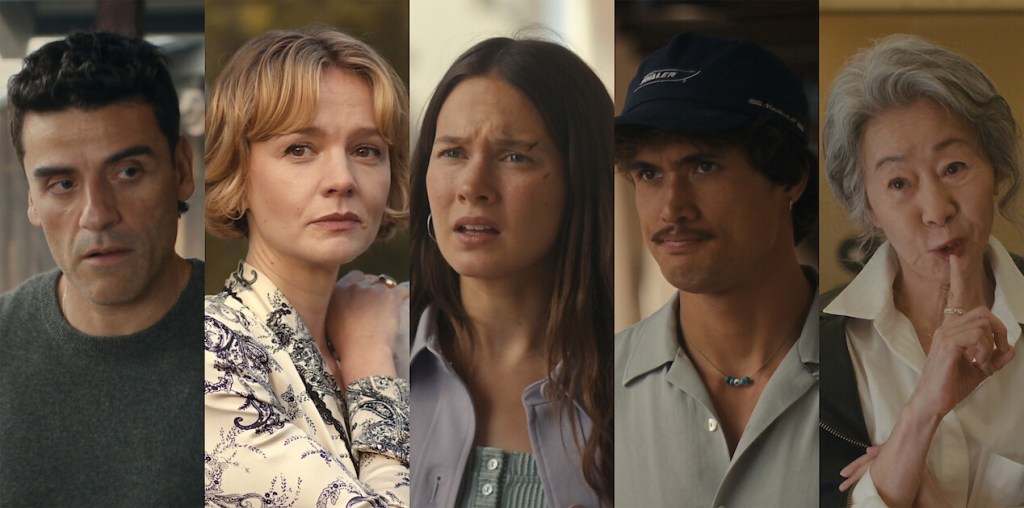
- The rich, unraveling power couple: Josh and Lindsay (played by Oscar Isaac and Carey Mulligan)
- The younger, ambitious couple: Ashley and Austin (played by Cailee Spaeny and Charles Melton)
Now here’s where things kick off: Ashley and Austin accidentally record a very heated argument between their boss (Josh) and his wife.
And instead of doing the normal, moral, human thing… they decide to softly blackmail them.
Career growth, baby.
And to be fair—it works.
For about five minutes.
Because from there, everything goes spectacularly off the rails.
The Plot: Or, How Many Subplots Is Too Many?
This is where I started to lose the plot. Quite literally.
Because just when you think you understand what the show is about—blackmail, power, class conflict—it starts piling things on:
- A Korean billionaire chairwoman running the club
- Financial manipulation and shady money trails
- Relationship breakdowns across both couples
- Identity crises (especially for Austin)
- A sudden trip to Korea
- Celebrity cameos and side characters popping in and out
At some point, it stops feeling like a story and starts feeling like a group project where no one agreed on the brief.
Yes, it’s ambitious. Yes, it’s layered. But it’s also… messy.
And not always in a good way.
The Relationships: Painfully Real, Uncomfortably Familiar
One thing the show absolutely nails is relationships.
Both couples—young and older—are basically mirrors of each other at different life stages.
There’s this underlying idea:
You look at older couples and think, “We’ll never become that.”
And then slowly, quietly… you do.
The resentment. The emotional distance. The performative happiness.
That part? Brutal. And very well done.
The Tone: What Are We Watching Exactly?
This is where the show gets tricky.
Is it:
- A dark comedy?
- A psychological drama?
- A social satire about class and privilege?
- A thriller?
The answer is… yes.
All of it.
At once.
And while Season 1 balanced tone beautifully, Season 2 feels like it’s constantly switching lanes without indicating.
One moment you’re laughing, the next you’re watching emotional breakdowns, and then suddenly you’re in a crime subplot involving hush money and cover-ups.
It’s a lot.
The Ending: Full Circle… or Full Confusion?
By the end, the show leans heavily into its central idea—cycles.
People don’t really change. They just evolve into slightly different versions of the same mess.
There’s betrayal, sacrifice, jail time, and a quiet, unsettling suggestion that the younger couple might just become the very people they once judged.
It’s poetic.
It’s bleak.
And honestly… a little exhausting.
Final Take
I really wanted to love this.
And parts of it are brilliant—especially the performances (Oscar Isaac and Carey Mulligan are incredible), and the sharp observations about class and relationships.
But overall?
It feels like a show that tried to say too many things at once—and ended up saying none of them clearly.
Verdict
If you enjoy layered, chaotic storytelling with multiple threads colliding—this is your jam.
If you like your narratives tight, focused, and emotionally clean… this might feel like a beautifully shot mess.
For me?
I think if I’d known it was this kind of ride… I might’ve just stayed in the parking lot.

