There’s something deeply unsettling about Defending Jacob, and the smartest thing the show does is that it never allows you the comfort of certainty. Eight episodes in, you’re still sitting there staring at the screen like an exhausted member of the Barber family thinking, “Okay… but did this child actually do it or not?”
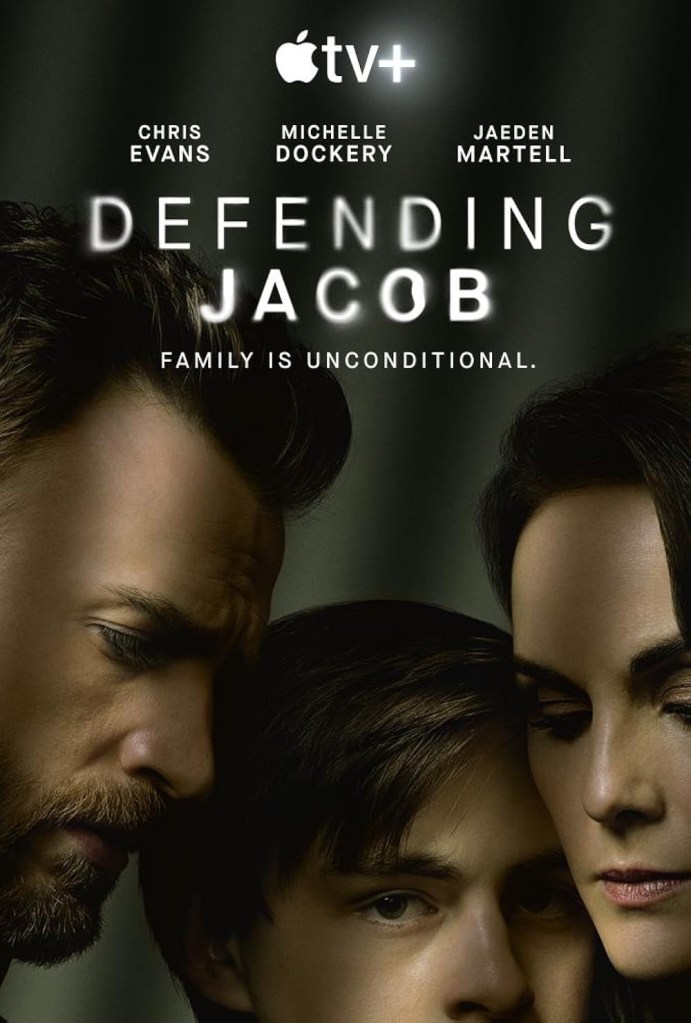
I landed on the series thanks to one of those random Instagram reels that algorithmically ambush your evening plans. One moody edit later and suddenly I was opening Apple TV + telling myself I’d “just watch one episode.” Which, of course, is the greatest lie humanity has told itself after “I’ll start my diet on Monday.”
Based on William Landay’s bestselling novel, the series revolves around Andy Barber, played by Chris Evans, who swaps Captain America’s shield for the permanent facial expression of a man who hasn’t slept in six months. Andy works at the district attorney’s office in a quiet Massachusetts town where a teenage boy is brutally stabbed. Soon, suspicion falls on Andy’s own son, Jacob Barber, played brilliantly by Jaeden Martell.
And this is where the series gets deliciously uncomfortable.
Jacob had a knife. Jacob says weird things. Jacob reacts to tragedy with the emotional energy of someone discussing WiFi speeds. But at the same time… Jacob also feels like a socially awkward teenager trapped inside an escalating nightmare. Every episode gives you evidence and then immediately pulls the rug from under you. It becomes less about solving the crime and more about watching an entire family psychologically unravel in slow motion.
The show is basically one long panic attack wrapped in excellent cinematography.
Michelle Dockery as Laurie Barber is phenomenal here. Slowly, quietly, devastatingly phenomenal. While Andy becomes increasingly determined to believe his son is innocent, Laurie begins drifting toward the terrifying possibility that Jacob may actually be capable of murder. The tension between the parents becomes the emotional backbone of the show. Their marriage slowly transforms from loving suburban partnership into two people desperately trying to survive opposite versions of reality.
And honestly, Chris Evans deserves more credit for this role than he gets. There’s a restrained desperation in his performance that works beautifully. He plays Andy like a man trying to hold water in his bare hands while pretending everything is fine. Also, watching Captain America lie, manipulate evidence, and emotionally combust is weirdly fascinating. Somewhere, Steve Rogers was probably watching all this in disappointment.
The supporting cast is equally solid. Pablo Schreiber plays Neal Logiudice, Andy’s colleague-turned-rival who takes over the case and proceeds to attack Andy with the enthusiasm of a man settling twelve years of office politics. Every interaction between them feels like a passive-aggressive LinkedIn endorsement turned homicidal.
Then there’s J.K. Simmons as Andy’s terrifying father, “Bloody Billy” Barber, whose violent past hangs over the family like a hereditary curse. The show constantly asks whether darkness can be inherited, whether violence is learned, genetic, or simply dormant. Andy fears Jacob may have inherited something monstrous, and that fear quietly infects every frame.
The series also introduces Leonard Patz, played by Daniel Henshall, a deeply unsettling suspect who allegedly made advances toward the murdered boy shortly before the killing. And just when you think the show is finally handing you answers, it throws another layer of doubt into the blender. Every clue creates fresh confusion. Every revelation somehow makes things murkier.
What I really liked was how human the uncertainty felt. Unlike shows where troubled teenagers are written with giant neon signs flashing “future serial killer,” Jacob remains impossible to fully read. Sometimes he appears innocent. Sometimes he says something so chilling you instinctively want to lock your doors. The audience ends up in the exact same psychological prison as the parents.
The comparisons to Adolescence are inevitable, but the difference is crucial. In Adolescence, the darkness feels more visible, more traceable. In Defending Jacob, ambiguity is the entire point. The show weaponizes uncertainty.
And then comes that ending.
Brace yourself for spoilers if you somehow skipped ahead like an absolute maniac.
Laurie eventually crashes the car carrying Jacob, hoping that in the face of death he’ll finally confess. But even then, the show refuses to give definitive closure. The family survives physically, but emotionally they’re destroyed beyond repair. Trust has evaporated. Love has become suspicion. Nobody knows what was true anymore.
That ambiguity will divide viewers. Personally, I thought the ending was powerful, though I do feel the series could have tied up a few threads more cleanly. After emotionally torturing us for eight episodes, the least the writers could have done was send over therapy vouchers and a detailed PowerPoint presentation titled “So Here’s What Actually Happened.”
Still, Defending Jacob remains one of Apple TV+’s strongest slow-burn thrillers — tense, emotionally exhausting, beautifully acted, and quietly haunting long after it ends. It’s less a murder mystery and more a study of parental fear: how far love stretches before doubt poisons it completely. And by the final episode, you realize the real mystery was never just Jacob.
It was whether a family can survive not knowing the truth.
 Honest Reviews