By the time we trundled into Ministry of Beer, North Goa edition, it was just past 10 pm and we were already one bad decision down — a tragic attempt to locate a place called Bar Outrigger, which we’re now convinced exists only in the imagination of a cartographer with a flair for mystery. After driving in loops, potentially disturbing a few cows and locals with our confused Google Maps tantrums, we gave up the ghost and headed to the more reliable, air-conditioned arms of the Ministry of Beer — a name that makes it sound like you’ll need a passport and clearance from the government to enter, but thankfully, no such paperwork was required.
And, thank heavens for valet parking, because trying to reverse on a North Goa street past 10 p.m. with a dozen scooters zipping past is no one’s idea of a relaxing evening.
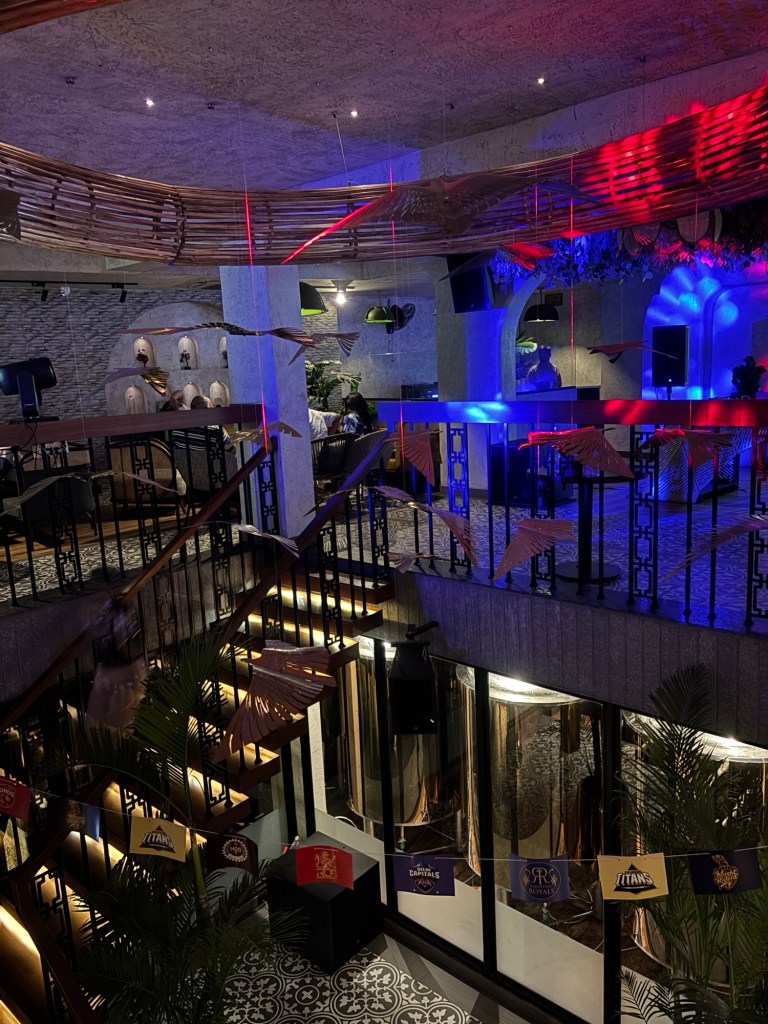
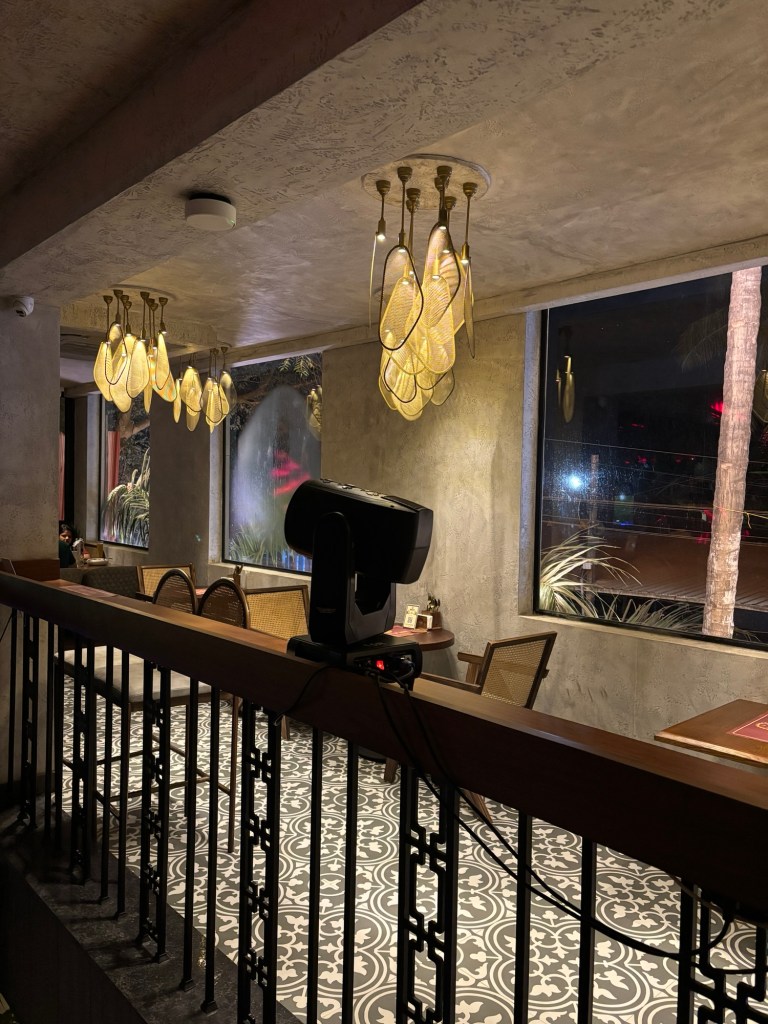
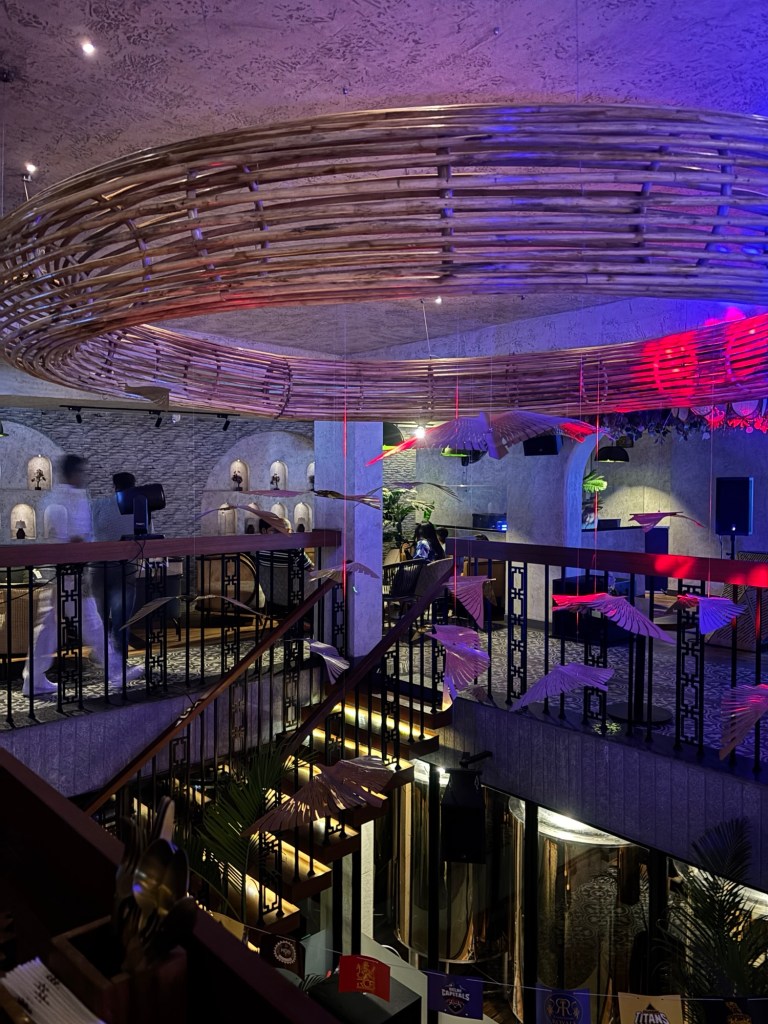
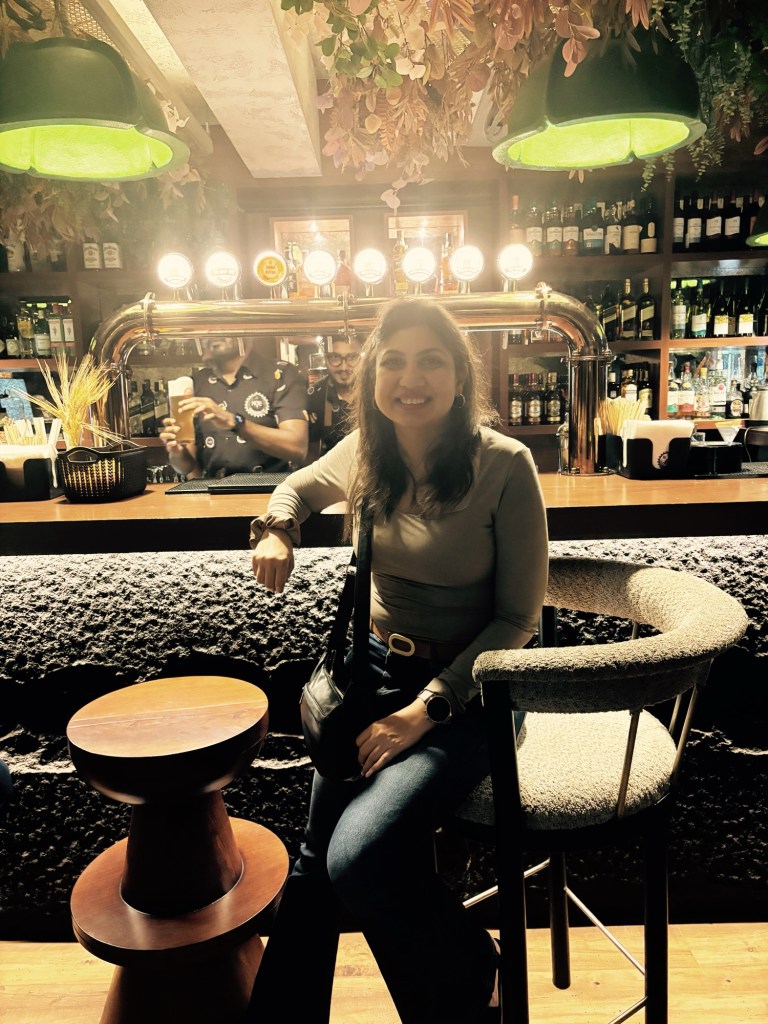
With two buzzing levels, the place felt like a stylish split-personality — upstairs for the party animals, downstairs for the craft beer philosophers— dark wood, green lights, swirling humans on the top floor and mugs of beer being whisked past. Families, couples on questionable third dates, and groups of lads doing what lads do best — wearing Hawaiian shirts unironically and pretending to understand craft beer — were scattered like confetti.
We parked ourselves on the opposite end of the thumping DJ setup, hoping our eardrums would last the night without lodging formal complaints. The music was unapologetically Bollywood — think Ranveer Singh’s energy level distilled into sound — and while normally this would make me internally sigh with a “Why God, why?”, something about the vibe made it tolerable. Dare I say… enjoyable? Perhaps it was the sheer infectious energy of a group breaking into a spontaneous dance, or perhaps the mango beer had started working its sweet tropical magic.
Ah yes, the beer. Let us talk about the beer. A server arrived with a flight of mini mugs — each adorably tiny, as though brewed by Smurfs — featuring an eclectic mix: mango, guava, espresso, three “regular” beers which I promptly renamed “The Reliable Triplets,” and one dark, broody type that whispered I’ll ruin your Sunday morning. The mango was like a beach holiday in a glass; the guava, weirdly nostalgic like the fruit you’d sneak out of someone’s garden; the espresso? A beer and a shot of coffee had a lovechild. We finally settled on the classic and the strong — a bit like dating: one’s dependable, the other’s thrilling but could land you in trouble.
For food, we ordered falafel and chicken dimsums. Now, the falafel was good, crispy on the outside and herbaceous inside, and frankly, I didn’t expect such Middle Eastern realness in a brewery.
The chicken dimsums arrived with that glorious shimmer of being freshly steamed, accompanied by chilli oil that was so deliciously fiery, I briefly considered bottling it and selling it on Etsy. We devoured both dishes while casually watching pool games that no one seemed to be winning, which only added to the charm.
Chicken Dimsums with Chilli Oil
The staff was pleasant, the kind who smile even when you’re pointing at the menu like a toddler unsure of their ice cream choice. The place had a sort of quiet confidence — not trying too hard, yet delivering the goods. The vibe was fun, the beer was excellent, and the food didn’t feel like a drunken afterthought.
In a world where too many bars try to be edgy and end up being tragic, Ministry of Beer manages to be that elusive creature: genuinely fun. Would I go back? Absolutely. Would I attempt to find Bar Outrigger again? Only if I’ve got a treasure map and a backup plan. Until then, I’ll raise a tiny mango beer to the good times, the bad directions, and an unexpectedly super Saturday night.
Slap a logo on it and suddenly it’s not a bag—it’s a ‘lifestyle.’”
Welcome to the digital fashion crime scene where TikTok detectives are cracking the case of the luxury markup. Exhibit A: A flood of reels from Chinese factories showing that the same luxury bags, shoes, and gadgets we shell out thousands for… might actually be born in the same factories as their $29.99 no-name cousins.
The only difference? A logo the size of a freckle and a price tag that makes your credit card whimper.
It’s the branding bombshell no one saw coming—until TikTok made it trendier than iced matcha on a Monday.
1: The Factory Feed is Piping Hot
Let’s set the scene. You’re scrolling TikTok, dodging dance trends and skincare serums, when BAM—you see a video of a Chinese factory proudly showcasing what looks eerily similar to a $4,000 designer handbag. Only here, it’s rolling off the line for $40 and packed in a cardboard box that says “EXPORT, GRADE A.”
Suddenly, you’re not just questioning that bag you mortgaged your soul for. You’re questioning everything.
Is luxury just… branding in high heels?
Spoiler: Kind of, yeah.
These factory TikToks are racking up millions of views faster than a Kardashian selfie. From Lululemon-style leggings to Birkenstock-inspired sandals, the vibe is clear: “Why pay $500 when the same thing is made here for $15, honey?”
2: Branding—The Real Luxury Item
Let’s get something straight. That swoosh on your sneakers? That little horsey with a polo stick? That fancy interlocking C?
That’s the real product.
You didn’t buy a bag. You bought a story. A brand. A whispered secret handshake into the world of “I have arrived.” Luxury branding is the art of turning cowhide into culture.
But now, TikTok has become a reverse-branding machine. It’s pulling back the velvet curtain and showing that the Emperor’s Gucci belt might be made in the same place as the no-name fanny pack next to it.
The horror!
3: Tariffs, TikTok, and Trade Trauma
Let’s not forget the geopolitical drama brewing underneath all this. With the U.S. throwing tariffs around like confetti, brands are paying more to import goods from China—which means YOU are paying more to be fabulous.
Enter Chinese sellers and platforms like DHGate, saying “Hey bestie, want the same look for one-tenth the cost?”—and TikTok influencers are eating it up like hot pot on a cold night.
Videos are going viral showing warehouse workers saying things like, “This is the same factory where [redacted] sends their orders. We just didn’t stitch the logo on this one.”
Oof. The shade is real. And you can’t put a price on this kind of petty transparency.
4: The Logo Tax: AKA Why Your Wallet is Crying
Let’s do some branding math:
Factory cost of leggings: $8 Add some packaging, marketing, shipping: +$10 Slap on a luxury logo: +$200 Retail price: $398 Moral of the story: You just paid for a vibe, not a fabric.
A logo, dear reader, is the world’s most expensive embroidery. It adds zero comfort to your feet, no extra room in your bag, but infinite confidence in your step. You know it. The brand knows it. TikTok knows it.
And now… everyone else does too.
5: But Wait—Is That Actually the Same Product?
Here’s where things get spicy.
Luxury brands like Lululemon and Adidas are calling “Fake News!” on these viral videos, insisting that the real deals come with quality checks, design specifics, and materials that knockoffs can’t replicate.
And sure—maybe they’re right. But here’s the kicker: Consumers want to believe the knockoff is close enough. Good enough. Almost the same. Because in the age of inflation, close counts.
If you’re walking into brunch with your faux Louis and no one bats an eye? Mission accomplished.
6: The Psychology of Flexing
Let’s talk brain chemistry.
Luxury purchases activate the same reward centers as gambling. You get a rush. You feel seen. You become That Girl/Guy/Nonbinary Baddie. And a logo is the ticket to that party.
TikTok’s behind-the-scenes factory tours? They’re raining on that dopamine parade.
When you realize your $700 sneakers cost $23 to make, it doesn’t feel like luxury anymore. It feels like you got finessed.
And now? People are skipping the finesse and heading straight to the source. They’re buying from “unbranded but suspiciously familiar” sellers. And they’re proud of it. It’s the new flex.
7: Branding in Crisis Mode
So what happens to the brands?
They double down on storytelling. They release origin videos with sepia filters showing artisans stitching with love and opera music in the background. They sue factories. They claim “innovation.” They rebrand logos as “heritage marks.”
But the question remains: Can branding survive when the curtain is pulled back?
Short answer: Yes. But not without evolving.
Brands must realize that the new luxury is transparency. Ethical production. Sustainability. A damn good story that holds up to a TikTok fact-check.
Because in 2025, a label isn’t enough. You need a why.
8: The Memeification of Luxury
Of course, the internet being the internet, has turned all this into comedy gold.
Reels titled:
“When your $4,000 purse has a Made in Shenzhen twin” “Me watching TikTok after buying real AirPods for $200” “My Louis bag after seeing her twin on DHGate for $30”
And the comment sections? Absolute chaos.
“So I’ve been paying $3,000 for a brand name and trauma?” “Catch me buying from China and gluing the logo myself.” “Alexa, play ‘Clowns’ by Tame Impala.”
9: What This Means for YOU (Yes, You, Fashion Icon)
Before you toss your designer wardrobe into a bonfire of existential dread, here’s the tea:
Branding still matters. That logo still tells a story. It’s okay to want the story. Know what you’re paying for. If it’s the vibe, own it. But don’t act surprised when the curtain gets pulled back. Authenticity is the new luxury. Buy what aligns with your values. Transparency. Fair wages. Real design.
And if you do score a $40 knockoff that slaps? You better walk that sidewalk like it’s a Paris runway.
Final Thoughts: The TikTok Era of Brand Enlightenment
What we’re seeing isn’t the death of branding—it’s its rebirth. In a world where everything can be exposed with one viral reel, the brands that will win are those that go beyond the logo. That stand for something real. That tell a story that even a factory worker would cosign.
And as consumers, we’re not being duped—we’re being educated. We’re not flexing blindly—we’re choosing with our eyes open.
So the next time you see a TikTok of a $4,000 bag being sewn beside a $40 one, smile knowingly. You’ve passed Branding 101.
Now go forth and label wisely.
P.S. If you’re wondering whether that TikTok factory actually makes your $600 sneakers… maybe ask your shoes. But be prepared for the answer.
They might just say: “Made in China. Marked up in Milan”
You know that show that’s been sitting on your Netflix queue forever? The one you keep scrolling past because you’re just not in the mood for something heavy? That was Adolescence for me. I’d seen the rave reviews, heard the whispers about its brilliance, but I wasn’t quite ready to dive into something so intense. And yet—one fine evening, I caved.
And now? Consider me utterly wrecked.
Adolescence
Adolescence isn’t just a show—it’s a gut-punch wrapped in raw emotion, sealed with phenomenal storytelling. Easily one of the most hard-hitting, thought-provoking series of the last five years, this limited series doesn’t just tell a story; it forces you to live it.
Not a Whodunit, But a Whydunit
Most crime dramas obsess over who pulled the trigger, who was lying, who had a secret. But Adolescence? It flips the script. As the director himself said, it’s not about the “whodunit” but the “whydunit”—and let me tell you, it achieves that goal with surgical precision.
Like peeling an onion (one that makes you cry uncontrollably), the series strips away layers of truth, guilt, and circumstance, unraveling the complexities of a family in crisis. You don’t just see what happens—you feel it, deep in your bones.
A Masterclass in Acting
This cast? Unbelievable. Every single actor delivers a performance so real, so lived-in, that you forget you’re watching fiction.
• The father (seriously, give this man an award now) is the definition of raw, unfiltered pain. His every sigh, every stare, every trembling word feels like it’s happening in your living room.
• The mother is just as powerful, perfectly matching his energy with a performance that oscillates between strength and shattering vulnerability.
• Jamie (the accused son)—this kid is phenomenal. One of the best young actors out there today, his portrayal is so layered, so eerily subtle, that you catch new nuances with every scene.
• The psychologist plays her role with a quiet authority that balances the chaos around her.
• The sister—well, let’s just say she represents a generation that’s growing up in an age of Instagram filters and self-curated personas, and she does it scarily well.
The police —what a performance. The calm in his voice, the way he never overplays his authority, but instead lets it seep through in his controlled, deliberate actions—it’s nothing short of spectacular.
The One-Take Episodes—Because Why Not Add More Genius?
Oh, and did I mention? The show pulls off one-take episodes. No cuts, no edits, just pure, uninterrupted emotion. It’s filmmaking at its bravest, and it works. The tension? Palpable. The realism? Unparalleled. The effect? A masterstroke.
A Show We Needed
In a world obsessed with likes, clout, and self-image, Adolescence is the wake-up call we didn’t know we needed. It holds a mirror to teenage pressures, family dynamics, and the horrifying reality of how quickly life can spiral.
It’s frustrating, heartbreaking, and painfully real. And if it makes even one parent, one teenager, stop and think—maybe, just maybe, it can save a life.
Final verdict? Watch it. Then take a deep breath. Then watch it again.
Hello, intrepid explorers and armchair adventurers! Ready to embark on a journey through the top 40 travel trends of 2025? Whether you’re planning a globetrotting escapade or an immersive Indian odyssey, we’ve curated 20 global trends and 20 homegrown trends to suit every wanderlust whim. So, fasten your seatbelts (or tighten your shoelaces), grab your sense of humor, and let’s dive into a travel trend extravaganza that’s as witty as it is insightful!
Global Travel Trends
1. Sustainable Tourism: Eco-consciousness is in vogue. Travelers are chasing destinations and accommodations that champion sustainability, reducing their carbon footprints one adventure at a time.
2. Personalized Luxury Experiences: Say goodbye to cookie-cutter vacations. The jet set now craves bespoke journeys—from private island hideaways to tailor-made culinary tours that cater to every quirky taste.
3. Multigenerational Travel: Family trips are evolving into epic reunions. Grandparents, parents, and kids are all packing together, proving that adventure truly is a family affair.
4. Bleisure Travel: Who says business trips can’t be fun? Professionals are blending work with play, extending meetings into mini-vacations that balance productivity with pleasure.
5. Passenger Pioneering: Adventurous souls are venturing off the beaten path, seeking authentic experiences in untouched corners of the world that remain delightfully undiscovered.
6. Set-Jetting: Film buffs are chasing movie magic, traveling to iconic filming locations and turning their favorite on-screen moments into real-life adventures.
7. Mindful Travel: More than just checking off bucket lists, travelers are embracing journeys with purpose—immersing themselves in local cultures and savoring every mindful moment.
8. AI-Assisted Planning: With artificial intelligence as the new travel agent, personalized itineraries and seamless bookings are making travel planning as breezy as a digital concierge.
9. Layover Leisure: Extended layovers are getting a makeover. Instead of sleeping in an airport lounge, travelers are exploring nearby cities, turning transit time into mini-adventures.
10. Concert Tourism: Music lovers are mapping out trips around live performances and festivals, where the thrill of a front-row seat meets the joy of discovering a new city.
11. Off-Peak Travel: Savvy travelers are dodging the crowds and premium prices by visiting destinations during their quiet seasons, where serenity reigns supreme.
12. Wellness Retreats: From Bali’s yoga sessions to Himalayan meditation hideaways, wellness getaways are helping globetrotters recharge both mind and body.
13. Digital Detox Trips: In a world of constant connectivity, some are choosing escapes with limited Wi-Fi—where the only notifications come from nature itself.
14. Culinary Tourism: Foodies are venturing out to sample authentic cuisines, transforming every meal into a delectable adventure that’s as Instagrammable as it is delicious.
15. Adventure Tourism: Thrill-seekers are chasing adrenaline—from skydiving over Dubai’s skyline to white-water rafting in New Zealand’s pristine rivers.
16. Heritage Tourism: History buffs are reconnecting with their roots, traveling to ancestral homelands and delving into the rich tapestry of their heritage.
17. Hyperloop Travel: Futuristic transport is on the horizon. High-speed pods promise to make short trips lightning-fast, turning weekend getaways into day trips.
18. Space Tourism: For those with a taste for the extraordinary (and deep pockets), commercial space flights are offering a once-in-a-lifetime, out-of-this-world experience.
19. Cruise Comeback: Cruises are reinventing themselves with boutique experiences, themed voyages, and eco-friendly practices, inviting travelers back to the high seas.
20. Virtual Reality Exploration: When physical travel isn’t on the cards, VR offers immersive journeys into far-off lands—all from the comfort of your living room.
Indian Travel Trends
21. Eco-Tourism in Sikkim: Sikkim’s lush landscapes and commitment to sustainability are drawing eco-friendly travelers who want to experience nature without leaving a heavy footprint.
22. Tech-Driven Tourism in Jaipur: Historic Jaipur meets high-tech as augmented reality guides and virtual tours bring centuries-old forts and palaces to life in new and exciting ways.
23. Offbeat Destinations like Ziro Valley: Beyond the well-trodden paths lie gems like Ziro Valley, where scenic beauty and unique tribal cultures offer an authentic slice of India.
24. Slow Travel in Kerala’s Backwaters: Houseboat cruises through Kerala’s enchanting backwaters allow travelers to soak up local culture at a leisurely pace—no rush, just pure relaxation.
25. Wellness Retreats in Rishikesh: Yoga, meditation, and spiritual rejuvenation await in Rishikesh, making it a must-visit for those seeking inner peace and a break from the daily grind.
26. Culinary Tours in Lucknow: Lucknow’s rich Awadhi cuisine, from succulent kebabs to aromatic biryanis, turns every meal into a culinary celebration that tantalizes the taste buds.
27. Digital Nomadism in Goa: Goa’s laid-back vibe, enhanced by reliable connectivity and co-working spaces, is turning it into a hotspot for remote workers balancing work and beach life.
28. Adventure Sports in Rishikesh: Beyond its spiritual allure, Rishikesh offers white-water rafting, bungee jumping, and other heart-pounding activities for the adventure-hungry.
29. Heritage Walks in Delhi: Delhi’s maze of history comes alive with guided heritage walks, where every narrow lane and ancient monument tells a captivating story.
30. Spiritual Journeys in Varanasi: Varanasi remains a timeless pilgrimage for those seeking spiritual awakening. Early morning boat rides on the Ganges and candlelit evening ceremonies evoke an almost magical atmosphere.
31. Mountain Escapes in Himachal Pradesh: The majestic peaks of Himachal beckon travelers with promises of crisp air, serene landscapes, and a chance to disconnect from the hustle.
32. Rural Retreats in Rajasthan: Beyond the opulent palaces lie rustic villages where travelers can experience authentic Rajasthani hospitality and participate in local crafts and traditions.
33. Wildlife Safaris in Madhya Pradesh: Home to national parks like Kanha and Bandhavgarh, Madhya Pradesh offers wildlife safaris that let you get up close and personal with India’s majestic fauna.
34. Festival Fever in Tamil Nadu: Tamil Nadu’s vibrant festivals, such as Pongal and Navaratri, offer a sensory overload of color, music, and cultural rituals that leave visitors spellbound.
35. River Cruises on the Ganges: Experience the Ganges like never before with luxurious river cruises that blend modern comfort with the ancient mystique of one of India’s most sacred rivers.
36. Cultural Homestays in the Northeast: In regions like Assam and Meghalaya, homestays provide an intimate look at local traditions and lifestyles—think home-cooked meals and heartfelt stories.
37. Colonial Charm in Pondicherry: Wander through the French Quarter of Pondicherry, where pastel-colored buildings and seaside cafés offer a quirky blend of European flair and Indian warmth.
38. North-East Exploration: The lesser-known states of the Northeast, like Mizoram and Manipur, are emerging as hotspots for travelers seeking pristine landscapes and a taste of indigenous culture.
39. Luxury Train Journeys: Indian Railways is rolling out opulent train services that combine the romance of yesteryear with modern luxury, taking travelers on scenic tours across the subcontinent.
40. Desert Glamping in Rajasthan: Swap the ordinary for the extraordinary by trying glamping in the Thar Desert. Enjoy luxurious tents under starlit skies, complete with traditional Rajasthani hospitality and camel rides.
As we reach the end of our travel trend tour, one thing’s crystal clear: 2025 is all about blending tradition with innovation, indulgence with responsibility, and exploration with meaningful connections. Whether you’re jetting off to far-flung corners of the globe or diving into the rich tapestry of India, these trends promise to transform every journey into a story worth telling. So go ahead—pack your bags, embrace the unexpected, and let the adventure of a lifetime begin!
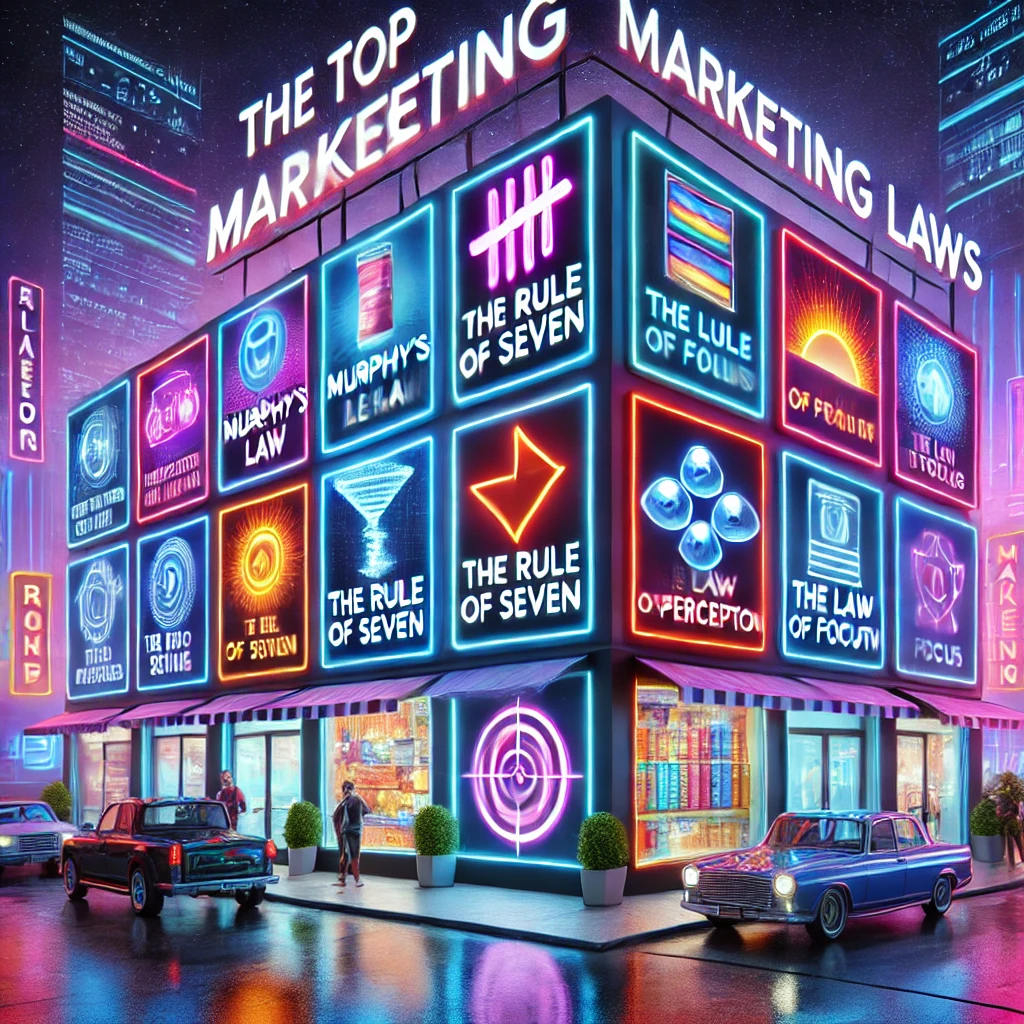
Welcome, dear reader, to the whimsical world of marketing laws! No, we’re not talking about the kind that requires a gavel and powdered wig. We’re diving into the unofficial commandments that govern the chaotic cosmos of advertising and branding. Think of these as the “Pirates’ Code” for marketers—guidelines rather than actual rules, but ignore them at your peril. Let’s embark on this journey through the top 15 marketing laws, sprinkled with real-world brand escapades.
1. Murphy’s Law: “Anything that can go wrong, will go wrong.”
Ah, Murphy’s Law—the eternal pessimist’s mantra. In marketing, this translates to: “Prepare for chaos, and then some.”
Case Study 1: Pepsi’s Kendall Jenner Ad Fiasco
In 2017, Pepsi launched an ad featuring Kendall Jenner, aiming to promote unity. Instead, it was accused of trivializing social justice movements. The backlash was swift, and Pepsi had to pull the ad, showcasing how even well-intentioned campaigns can go horribly wrong.
Case Study 2: Hoover’s Free Flights Promotion
In the early ‘90s, Hoover UK offered free flights to the U.S. for customers who purchased £100 worth of products. The promotion was so popular that Hoover couldn’t fulfill the flight requests, leading to a PR disaster and significant financial losses.
2. Parkinson’s Law: “Work expands to fill the time available for its completion.”
In marketing, this means campaigns will take as long as you allow them to—deadlines are your friend.
Case Study 1: Apple’s Product Launches
Apple’s meticulously planned product launches are a testament to setting strict deadlines. Each launch is timed perfectly, creating anticipation and ensuring timely delivery.
Case Study 2: Volkswagen’s “Think Small” Campaign
In the 1960s, Volkswagen’s agency, Doyle Dane Bernbach, operated under tight deadlines to produce the iconic “Think Small” campaign. The time constraints led to focused creativity, resulting in one of the most successful ads in history.
3. The Law of the Few (from The Tipping Point): “A tiny percentage of people do the majority of the work.”
In marketing, influencers and key opinion leaders often drive trends.
Case Study 1: Nike’s Collaboration with Michael Jordan
Nike’s partnership with Michael Jordan led to the creation of the Air Jordan line, revolutionizing athletic footwear and setting sales records, all driven by the influence of one athlete.
Case Study 2: Oprah’s Book Club
Books featured in Oprah’s Book Club often become bestsellers overnight, demonstrating the impact a single influencer can have on consumer behavior.
4. The Pareto Principle (80/20 Rule): “80% of effects come from 20% of causes.
In marketing, a significant portion of sales often comes from a small fraction of customers.
Case Study 1: Amazon Prime
Amazon identified that a small percentage of loyal customers accounted for a large portion of sales. Introducing Amazon Prime enhanced their shopping experience, increasing overall revenue.
Case Study 2: Coca-Cola’s Focus on Core Products
Coca-Cola generates most of its revenue from a few core products, leading them to focus marketing efforts on these bestsellers.
5. Goodhart’s Law: “When a measure becomes a target, it ceases to be a good measure.”
Overemphasis on specific metrics can lead to manipulation, rendering them ineffective.
Case Study 1: Wells Fargo’s Sales Quotas
Wells Fargo’s aggressive sales targets led employees to create fake accounts to meet goals, resulting in a major scandal and loss of customer trust.
Case Study 2: Facebook’s Video Metric Inflation
Facebook’s overemphasis on video views led to inflated metrics, misleading advertisers about the effectiveness of their campaigns.
6. The Peter Principle: “Employees rise to their level of incompetence.”
In marketing, promoting without proper assessment can lead to inefficiency.
Case Study 1: JC Penney’s CEO Misstep
JC Penney hired Ron Johnson, who implemented drastic changes without understanding the brand’s core customers, leading to a significant drop in sales.
Case Study 2: New Coke Debacle
Coca-Cola’s decision to introduce New Coke in 1985, led by executives out of touch with consumer preferences, resulted in a public outcry and the return of the original formula.
7. The Streisand Effect: “Attempting to hide information only makes it more widespread.”
In the digital age, trying to suppress information can backfire spectacularly.
Case Study 1: McDonald’s #McDStories Campaign
McDonald’s Twitter campaign encouraging customers to share positive stories led to a flood of negative experiences, amplifying criticism.
Case Study 2: United Airlines’ Passenger Incident*
United Airlines’ attempt to downplay the forcible removal of a passenger led to viral videos and global outrage, damaging the brand’s reputation.
8. The Halo Effect: “Positive impressions in one area lead to positive impressions in another.”
A strong brand image can enhance perceptions across all products.
Case Study 1: Apple’s Ecosystem
Apple’s reputation for quality in computers extended to its other products, like the iPhone and iPad, boosting overall brand perception.
Case Study 2: Toyota’s Lexus Launch
Toyota’s reputation for reliability helped establish Lexus as a trustworthy luxury brand.
9. The Pygmalion Effect: “Higher expectations lead to improved performance.”
Belief in a campaign’s success can boost team morale and outcomes.
Case Study 1: Dove’s Real Beauty Campaign
Belief in promoting real beauty standards led to a successful campaign that resonated with consumers and boosted sales.
Case Study 2: Nike’s “Just Do It” Campaign
Nike’s internal belief in empowering athletes translated into a campaign that inspired consumers and elevated the brand.
10. The Boomerang Effect: “Persuasive attempts can result in the adoption of opposing views.”
Overly aggressive marketing can drive consumers away.
Case Study 1: Sony’s Fake PSP Blog
Sony’s attempt to create a fake blog to promote the PSP was met with backlash, leading to negative publicity.
Case Study 2: McDonald’s “I’d Hit It” Campaign
Aimed at younger audiences, the campaign’s slang was misinterpreted, leading to ridicule and a quick withdrawal.
11. The Law of Unintended Consequences: “Actions can have unforeseen effects.”
Campaigns can lead to unexpected outcomes, not always positive.
Case Study 1: Starbucks’ “Race Together” Campaign
Starbucks’ initiative to encourage conversations about race was criticized as tone-deaf, leading to public backlash.
Case Study 2: Burger King’s “Whopper Neutrality” Campaign
An attempt to explain net neutrality through a Whopper pricing stunt confused customers and led to mixed reactions.
12. The Law of Diminishing Returns: “Increasing investment yields progressively smaller returns.”
Imagine pouring water into a glass. Initially, each pour significantly fills the glass, but as it nears capacity, additional water has less impact and eventually overflows. In marketing, this principle suggests that after a certain point, increasing investment in a particular strategy or channel results in progressively smaller gains.
Case Study 1: Google’s Ad Spend Saturation
Companies investing in Google Ads often experience diminishing returns as they scale up their budgets. Initially, increasing ad spend leads to higher impressions and conversions. However, beyond a certain threshold, the cost per acquisition rises, and the return on advertising spend (ROAS) declines. This occurs because the most receptive audiences are reached first; additional spending attempts to engage less interested users, leading to reduced efficiency. Recognizing this saturation point is crucial to optimize ad budgets effectively.
Case Study 2: Content Marketing Overload
A tech startup launched an aggressive content marketing strategy, publishing daily blog posts, whitepapers, and videos. Initially, website traffic and engagement soared. However, as the content volume increased, the quality declined, leading to audience fatigue and decreased engagement. The company’s failure to recognize the diminishing returns of excessive content production resulted in wasted resources and a diluted brand message.
13. The Law of Unintended Consequences: “Actions can have unforeseen effects.”
Even the best-laid marketing plans can lead to unexpected outcomes, sometimes counteracting the original intent.
Case Study 1: Social Cause Advertising Backfire
A company launched a campaign highlighting a social cause, featuring advertisements depicting violent situations to raise awareness. While aiming to promote positive change, the ads inadvertently triggered aggressive thoughts among certain audience segments, particularly individuals with predispositions toward aggression. This unintended consequence highlighted the need for careful consideration of content and audience sensitivities in cause-related marketing.
Case Study 2: Ford’s Corporate Jet Policy
Ford Motor Company, in an effort to cut costs, implemented a policy requiring executives to use chartered jets instead of company-owned aircraft. This decision led to increased expenses due to higher charter costs and logistical inefficiencies. Additionally, it resulted in job losses among transportation staff. The policy, intended to reduce expenditures, ultimately exemplified the law of unintended consequences by causing financial and human resource setbacks.
14. The Law of Reciprocity: “People tend to return favors.”
In marketing, offering something of value can encourage customers to respond positively, fostering loyalty and engagement.
Case Study 1: Sephora’s Beauty Insider Program
Sephora offers a loyalty program where members receive free samples, birthday gifts, and exclusive access to products. This generosity encourages customers to make repeat purchases, as they feel compelled to reciprocate the brand’s goodwill.
Case Study 2: HubSpot’s Free Tools
HubSpot provides free marketing tools and resources to businesses. By offering value upfront, they establish trust and encourage users to consider their paid services when scaling their operations.
15. The Law of Social Proof: “People follow the actions of others.”
Consumers often look to others’ behaviors and opinions to guide their own decisions, especially in uncertain situations.
Case Study 1: Amazon’s Customer Reviews
Amazon prominently features customer reviews and ratings for products. Positive reviews serve as social proof, influencing potential buyers to make purchases based on others’ experiences.
Case Study 2: McDonald’s “Billions Served” Signage
McDonald’s displays signs stating “Billions Served,” signaling widespread customer approval. This social proof reassures potential customers of the brand’s popularity and reliability.
16. The Rule of Seven: “A prospect needs to see or hear your marketing message at least seven times before they take action.”
This classic marketing principle suggests that potential customers require multiple exposures to a message before making a purchase decision. The idea is to build familiarity and trust through repeated interactions.
Case Study 1: Coca-Cola’s Consistent Advertising
Coca-Cola has long embraced the Rule of Seven by maintaining a consistent and omnipresent advertising strategy. From television commercials to billboards and sponsorships, the brand ensures that consumers encounter its messaging repeatedly, reinforcing brand recognition and encouraging purchases.
Case Study 2: Local Service Providers’ Direct Mail Campaigns
Local businesses often utilize direct mail campaigns, sending out flyers and postcards multiple times to the same households. By adhering to the Rule of Seven, these service providers increase the likelihood that potential customers will remember their offerings and reach out when in need of their services.
17. The Law of Perception: “Marketing is not a battle of products, it’s a battle of perceptions.”
This law emphasizes that consumer perception, rather than the actual product, dictates market success. Shaping how customers perceive a brand can be more critical than the product’s inherent qualities.
Case Study 1: Apple’s Premium Image
Apple has cultivated a perception of innovation and premium quality, allowing it to command higher prices despite comparable alternatives. This perception is reinforced through sleek design, high-profile product launches, and a focus on user experience.
Case Study 2: Listerine’s “Tastes Bad, Works Great” Campaign
Listerine turned a negative—its strong taste—into a positive by positioning it as proof of effectiveness. This strategic shift in perception helped Listerine dominate the mouthwash market.
18. The Law of Focus: “A company becomes more powerful when it focuses on one thing.”
Specialization can lead to a stronger brand identity and market dominance. By concentrating efforts on a single product or service, companies can become synonymous with that offering.
Case Study 1: Domino’s Pizza’s Delivery Promise
Domino’s focused on fast delivery with its “30 minutes or it’s free” guarantee. This singular focus differentiated it from competitors and built a loyal customer base.
Case Study 2: Volvo’s Safety Emphasis
Volvo concentrated its marketing on vehicle safety, leading consumers to associate the brand with reliability and protection, setting it apart in the automotive industry.
19. The Law of Exclusivity: “Two companies cannot own the same word in the prospect’s mind.”
Once a brand becomes associated with a particular attribute, it’s challenging for competitors to claim the same position.
Case Study 1: FedEx’s “Overnight” Delivery
FedEx established itself as the leader in overnight shipping. Competitors attempting to adopt the same positioning struggled to change consumer perception.
Case Study 2: BMW’s “Ultimate Driving Machine”
BMW’s branding around driving performance made it difficult for other car manufacturers to position themselves similarly without appearing imitative.
20. The Law of the Category: “If you can’t be first in a category, set up a new category you can be first in.”
Creating a new market category can position a brand as a leader without direct competition.
Case Study 1: Southwest Airlines’ Low-Cost Carrier Model
Southwest Airlines introduced the low-cost carrier category, differentiating itself from traditional airlines and attracting cost-conscious travelers.
Case Study 2: Cirque du Soleil’s Circus-Theater Hybrid
Cirque du Soleil combined elements of circus and theater, creating a unique entertainment category and achieving global success.
Key Takeaways:
1. Repetition Builds Recognition: The Rule of Seven highlights the importance of consistent messaging to foster familiarity and trust.
2. Perception Shapes Reality: The Law of Perception underscores the need to manage how consumers view your brand, sometimes outweighing the product’s actual attributes.
3. Focus Drives Strength: The Law of Focus demonstrates that specializing in a particular area can lead to a stronger market presence.
4. Own Your Unique Attribute: The Law of Exclusivity suggests that establishing a unique brand association makes it challenging for competitors to encroach on your positioning.
5. Create Your Niche: The Law of the Category encourages innovation by establishing new market segments where your brand can lead.
Conclusion:
Understanding and applying these marketing laws can provide strategic advantages in building and maintaining a strong brand presence. By focusing on consumer perceptions, consistent messaging, and carving out unique market positions, businesses can navigate the competitive landscape more effectively and foster lasting connections with their audiences.
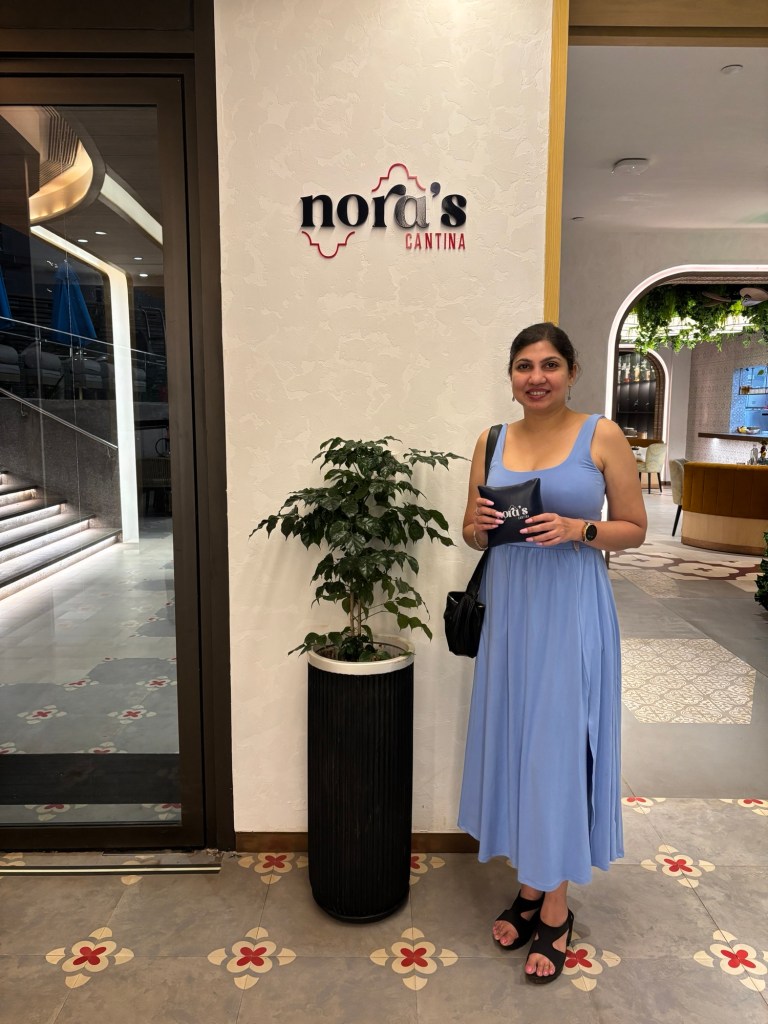
Some Saturday nights, you crave chaos—the kind of place where elbows knock over cocktails and the music competes with a hundred conversations. Other times, you want something quieter, a little more dignified, preferably somewhere that doesn’t involve fighting off a group of teenagers for the last barstool. This Saturday, we were in the latter mood. Enter Nora’s Cantina, tucked inside Novotel, Panaji, a hotel that has quickly integrated into the vibrant fabric of the city.
Bar Area
It’s new, it’s shiny, and, as we correctly predicted, it’s not the sort of place where you’d struggle to get a table.
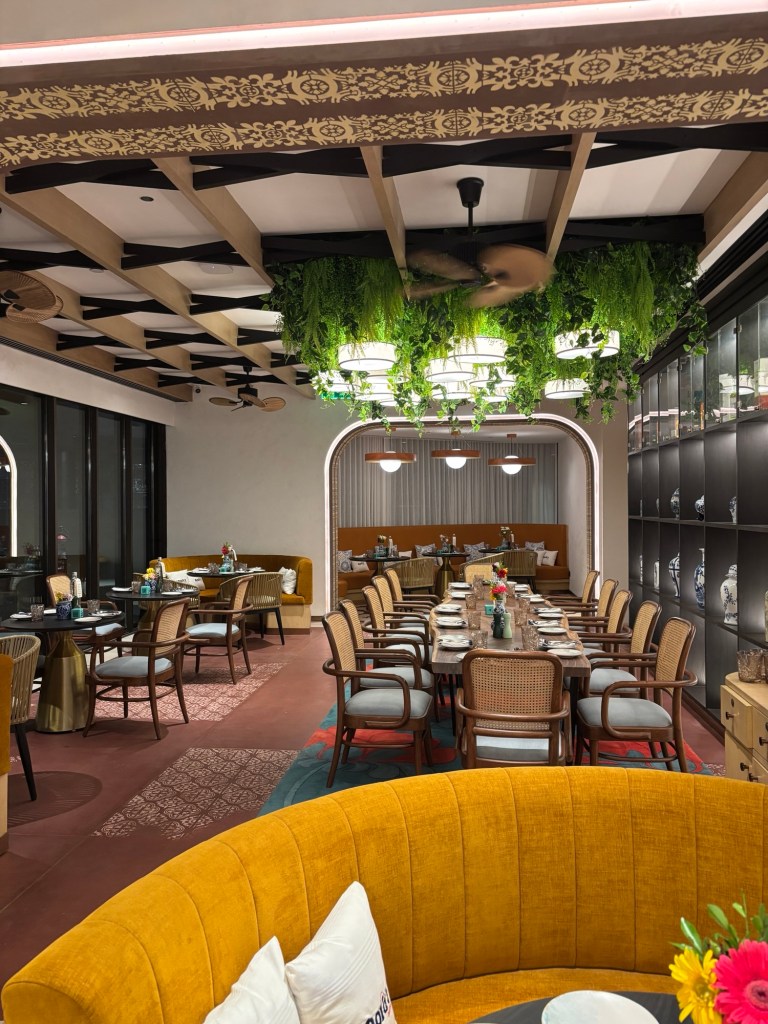
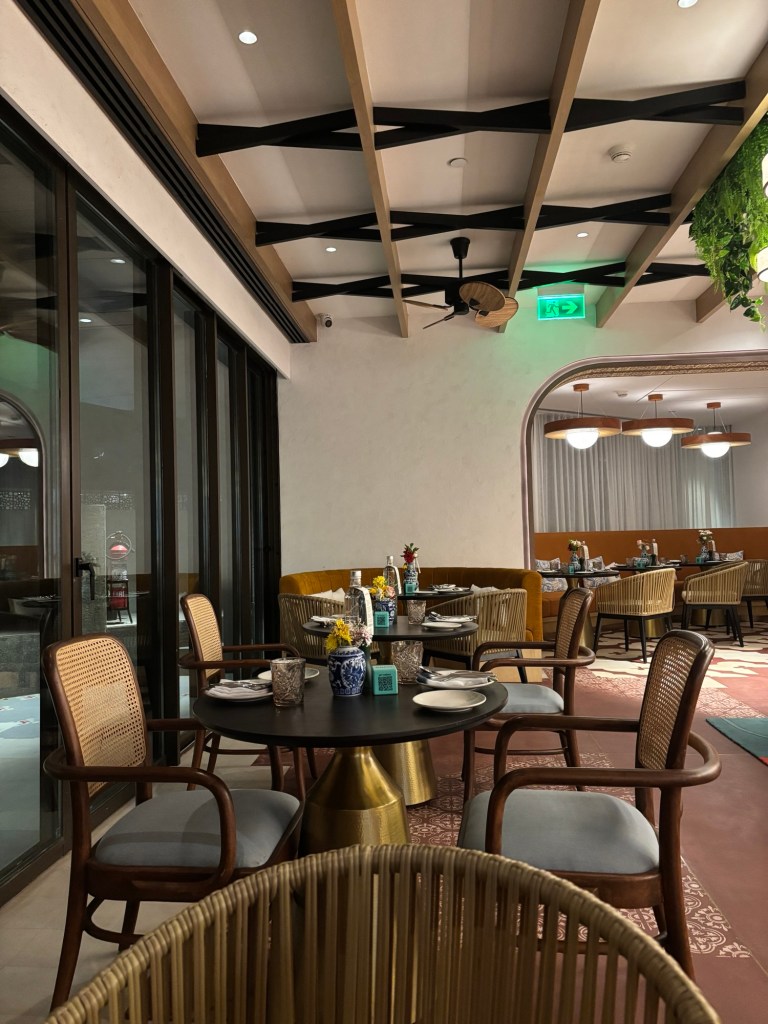
Now, let’s start with the look and feel. The restaurant is spacious, and they’ve done it up well. But here’s the thing—it’s a “Cantina” that serves Spanish and Portuguese cuisine. So naturally, I walked in expecting warm, rustic vibes, maybe a hint of old-world Iberian charm, something that whispered fiesta rather than murmured corporate hotel dining. Instead, I was greeted by an aesthetic that felt like someone had skimmed a Mediterranean travel guide but got bored halfway through. But hey, I wasn’t here to critique the wallpaper. I was here for the food.
Seating Interiors
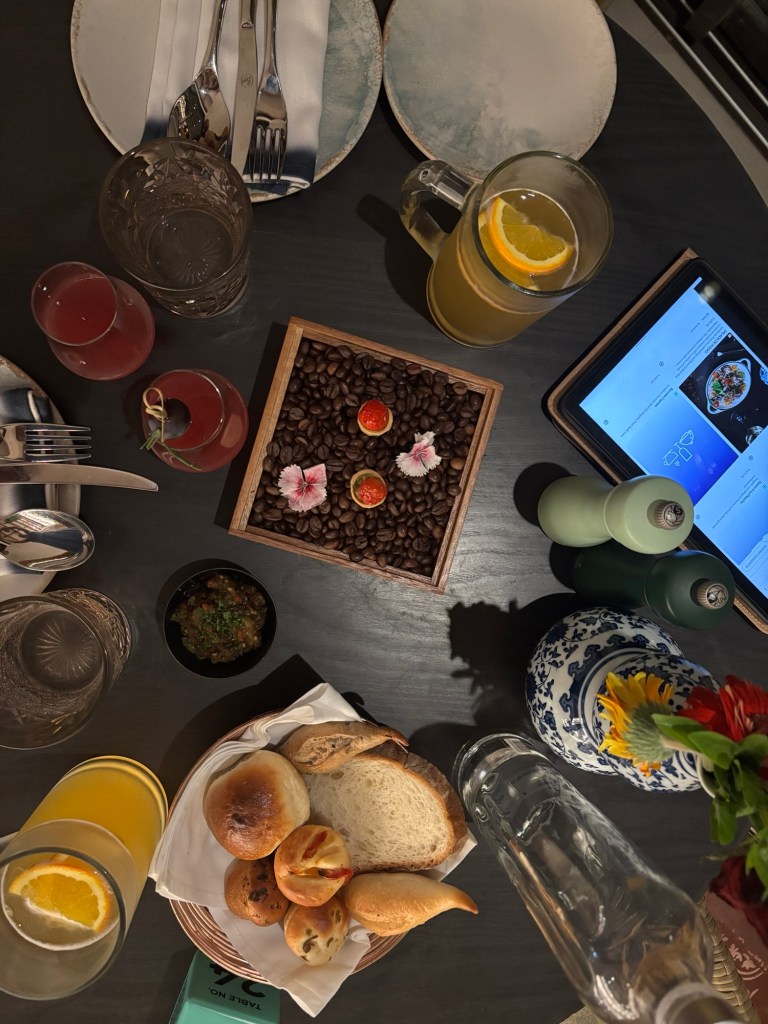
The evening commenced with a complimentary aperitif—a gesture that, in many establishments, might be a token offering. Here, however, it was a masterstroke: a delicate concoction that danced on the palate, hinting at ginger and other spices.
Aperitif
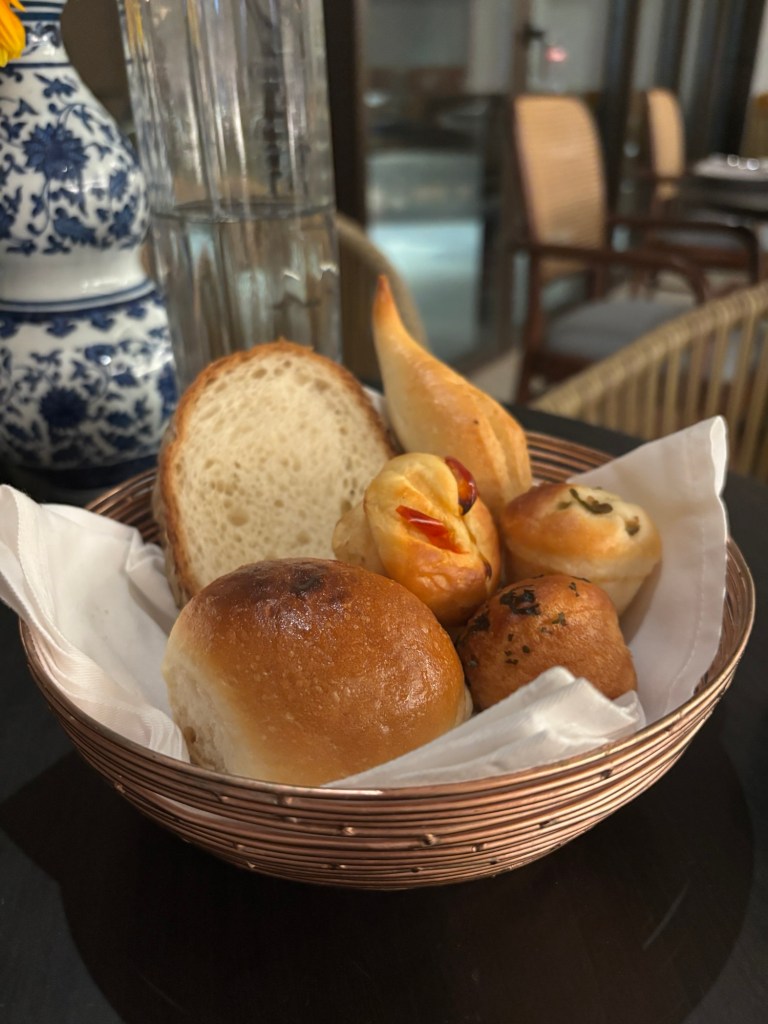
Accompanying this was a trio of amuse-bouches—a whisper of the chef’s intentions. The bread basket, often an overlooked prelude, arrived as an ensemble of artisanal loaves, each exuding warmth and an aroma that beckoned immediate indulgence.
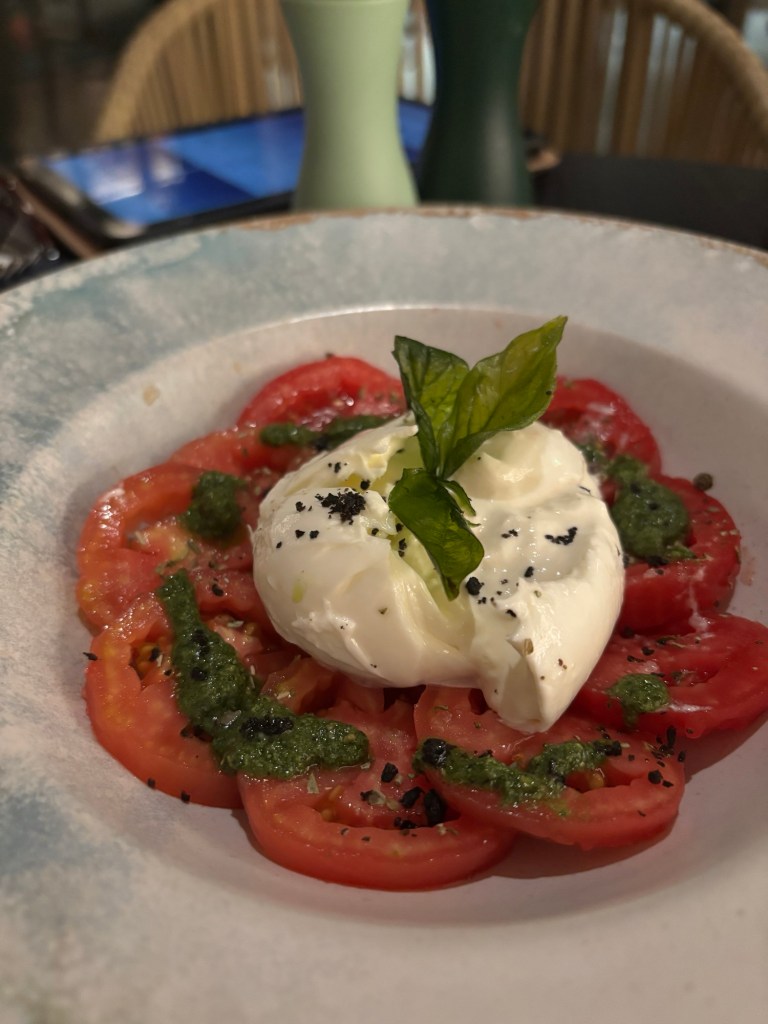
Our first order : Burrata Caprese. Now, I’ve eaten my way through enough burratas to know that when done right, they are clouds of creamy perfection, a little drizzle of something olive-oily and herby making them even better.
Burrata Caprese
But what arrived at the table was a burrata perched atop sliced tomatoes in a way that suggested someone had given up halfway through plating. No dressing. No excitement. Just… burrata and tomato, looking like they were having an awkward first date.
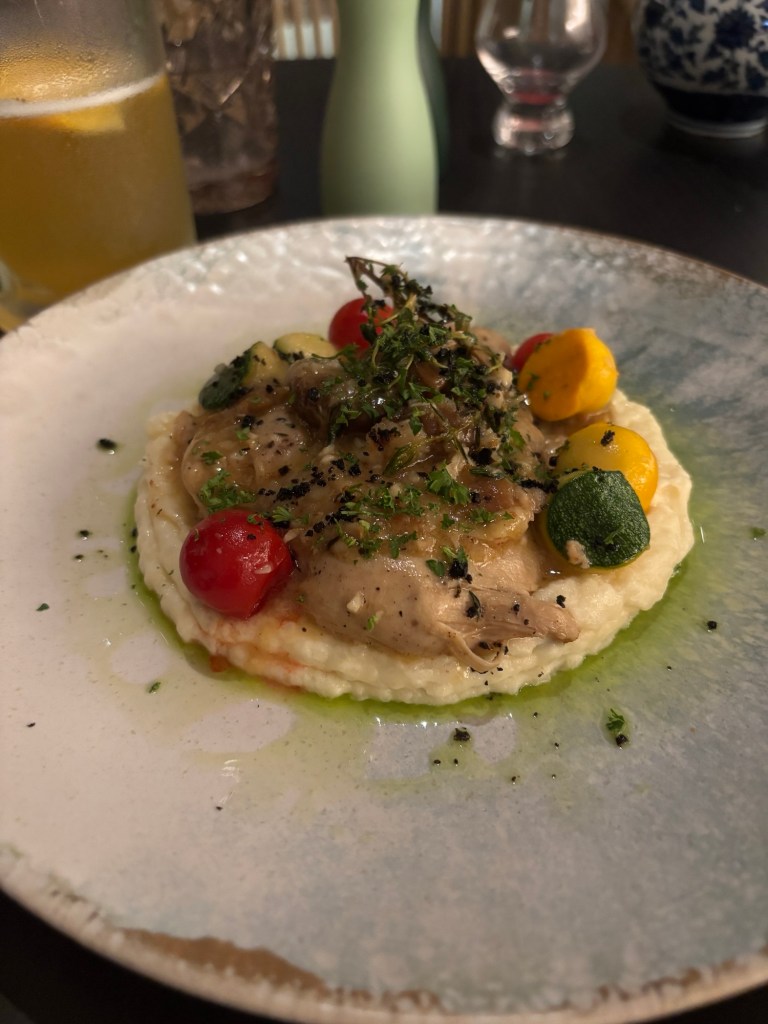
Then came the savior of the evening: Pollo Alla Antigua, Braised Chicken cooked in white wine, figs and rosemary. Now, this is where things took a turn for the better.
Pollo Alla Antigua
The chicken was tender, beautifully done, and happily set atop a composition of potato mash. The apricot added a nice sweet kick, the mashed potatoes were creamy, and the cherry tomatoes added a pop of freshness. Finally, we were on the right track.
Then came dessert. And this is where things got serious. We ordered a chocolate dessert, which arrived looking too pretty to eat—but eat it we did. It was chocolate upon chocolate, a dessert that doesn’t whisper sweet nothings but instead shouts, “You better love cocoa, or else.” Deep, indulgent, and strictly for people who aren’t afraid to commit to chocolate.
But the real star of the evening? The Churros Con Chocolate. These arrived as a complimentary gift from the kitchen—which was a lovely gesture from Sous Chef Utsha. Either way, these churros were phenomenal. Light, crispy, and creamy, they made me momentarily consider moving in. If there was a single reason to return to Nora’s Cantina, these churros might be it.
Churros Con Chocolate
So, the final verdict: Would I go back? Hmm. Panaji is bursting with restaurants vying for attention. In a city where culinary delights beckon from every corner, Nora’s Cantina at Novotel Goa Panjim offers a pleasant dining experience. While it may not be the most avant-garde establishment in Panaji’s bustling food scene, its warm ambiance and attentive service provide a comforting retreat. Would I return? Perhaps, on an evening when familiarity and ease are the desired companions.
The service was lovely. The chef and serving staff were warm, welcoming, and clearly eager to make sure we had a good time. And sometimes, that’s enough to tempt you back for round two.
Let’s face it: planning a trip is like trying to solve a Rubik’s Cube blindfolded. You’ve got flights to book, hotels to compare, and a budget that’s tighter than your jeans after Thanksgiving dinner. Enter Online Travel Agencies (OTAs), the unsung heroes of modern travel. These platforms are like fairy godmothers for wanderlust-stricken souls, waving their digital wands to turn your travel dreams into reality—or at least into a confirmed booking.
But in a world where everyone’s selling something, how do the best OTAs stand out? Buckle up, because we’re about to take a hilarious, no-holds-barred tour of their branding and marketing strategies.
1. Booking.com: The Overachiever of OTAs
If OTAs were high school students, Booking.com would be the valedictorian who also captains the debate team and volunteers at the animal shelter. This platform doesn’t just sell travel; it sells options. Flights, hotels, car rentals, and even quirky stays like treehouses and igloos—Booking.com has it all.
Branding Genius:
Tone: Friendly, reliable, and slightly pushy (in a “Book now, only 2 rooms left!” kind of way).
Tagline Potential:“Booking.com: Because Spontaneity is Overrated.”
Marketing Move: Their “Booking.Yeah!” campaign is a masterclass in simplicity and humor. It’s like they looked at all the travel ads out there and said, “Nah, let’s keep it real.”
Funny Observation: Booking.com’s countdown timers are the digital equivalent of a salesperson following you around the store saying, “It’s the last one!” You know it’s probably a marketing gimmick, but you still panic and hit “Book Now.”
2. Expedia: The OG of OTAs
Expedia is the granddaddy of OTAs, the platform that was there when dial-up internet was still a thing. It’s like your favorite uncle who always has travel tips and knows how to get the best deals.
Branding Genius:
Tone: Trustworthy, experienced, and slightly nostalgic (like your favorite uncle who always has travel tips).
Tagline Potential:“Expedia: Because You Deserve a Vacation (and a Discount).”
Marketing Move: Their rewards program makes you feel like you’re winning at life, even if you’re just booking a budget motel.
Funny Observation: Expedia’s bundles are so good, you’ll convince yourself you need a rental car even if you’re just going to the beach. “But honey, it’s a $50 discount! We’re basically saving money!”
3. Airbnb: The Cool Kid of Stays
Airbnb isn’t just about booking a place to sleep; it’s about experiences. From cozy cabins to luxurious villas, they’ve redefined what it means to travel.
Marketing Move: They turned their hosts into influencers and made “unique stays” a thing.
Funny Observation: Airbnb’s listings make you believe you’ll find yourself in a yurt in Mongolia. Spoiler: You’ll probably just find Wi-Fi issues. But hey, at least you’ll have a great story for Instagram.
4. Kayak: The Sherlock Holmes of Travel Search
Kayak doesn’t sell travel; it helps you find the best deals across multiple platforms. It’s like having a personal assistant who’s way too invested in your vacation plans.
Branding Genius:
Tone: Smart, efficient, and slightly nerdy (like your friend who always finds the best deals).
Tagline Potential:“Kayak: Because Your Time is Worth More Than a $10 Discount.”
Marketing Move: Their “Travel Hacker Guide” series is pure genius, offering tips and tricks for savvy travelers.
Funny Observation: Kayak’s price alerts are the digital equivalent of a personal assistant who’s way too invested in your vacation plans. “Hey, just wanted to let you know that flight to Bali dropped by $20. You’re welcome.”
5. Skyscanner: The Minimalist of OTAs
Skyscanner is all about simplicity. Their clean interface and flexible search options make it easy to find the best deals.
Branding Genius:
Tone: Clean, straightforward, and slightly Scandinavian (think IKEA, but for travel).
Tagline Potential:“Skyscanner: Because Travel Shouldn’t Be Complicated.”
Marketing Move: Their “Everywhere Search” feature is perfect for indecisive travelers.
Funny Observation: Skyscanner’s “Everywhere Search” is like throwing a dart at a map and hoping for the best. “Hmm, should I go to Paris or Prague? Let’s see where the algorithm takes me!”
6. TripAdvisor: The Yelp of Travel
TripAdvisor is the go-to platform for reviews, recommendations, and planning your entire trip. It’s like having a million travel agents at your fingertips, each with their own opinions and dramatic flair.
Branding Genius:
Tone: Honest, community-driven, and slightly dramatic (like a Yelp review written in ALL CAPS).
Tagline Potential:“TripAdvisor: Because Your Friends Don’t Know Everything.”
Marketing Move: Their “Travelers’ Choice Awards” are the Oscars of the travel world.
Funny Observation: TripAdvisor reviews are the digital equivalent of asking a stranger for restaurant recommendations and getting their entire life story. “The food was great, but let me tell you about my divorce…”
7. MakeMyTrip: The Bollywood of OTAs
MakeMyTrip is India’s answer to the global OTA giants, and it does it with a flair that’s as colorful as a Bollywood dance number.
Branding Genius:
Tone: Energetic, aspirational, and slightly dramatic (like a Bollywood movie trailer).
Tagline Potential:“MakeMyTrip: Because Your Vacation Deserves a Soundtrack.”
Marketing Move: Their ads are a mix of humor, emotion, and star power (hello, Alia Bhatt and Ranveer Singh).
Funny Observation: MakeMyTrip’s ads make you feel like your vacation will be a blockbuster hit. Spoiler: It’s more like an indie film with a shoestring budget.
8. EaseMyTrip: The Friendly Neighbor of OTAs
EaseMyTrip is like that friendly neighbor who always has the best advice and never charges you for it.
Branding Genius:
Tone: Approachable, helpful, and slightly cheeky (like your favorite aunt who knows all the gossip).
Tagline Potential:“EaseMyTrip: Because Travel Shouldn’t Be a Headache.”
Marketing Move: Their “No Convenience Fee” policy is a game-changer, making them the Robin Hood of OTAs.
Funny Observation: EaseMyTrip’s no-fee policy makes you feel like you’re sticking it to the man. “Take that, corporate overlords!”
9. Cleartrip: The Minimalist Maverick of OTAs
Cleartrip is all about simplicity and efficiency, like the Marie Kondo of travel platforms.
Branding Genius:
Tone: Clean, efficient, and slightly zen (think yoga retreat meets travel booking).
Tagline Potential:“Cleartrip: Because Travel Should Spark Joy.”
Marketing Move: Their user-friendly interface and straightforward pricing make them a favorite for no-nonsense travelers.
Funny Observation: Cleartrip’s simplicity is so refreshing, you’ll wonder why other OTAs feel the need to complicate things. “Why use 10 clicks when 2 will do?”
Conclusion: The Future of OTAs
So, what’s the secret sauce of these OTAs? It’s simple: they’re not just selling travel; they’re selling dreams. Whether it’s Booking.com’s endless options, Expedia’s bundled deals, or Airbnb’s unique stays, these platforms know how to make you click, book, and dream.
But let’s be real: while these OTAs make you feel like you’re planning the trip of a lifetime, you’re probably just sitting on your couch in sweatpants. And that’s okay. Because sometimes, the best journeys are the ones you take in your imagination—preferably with snacks.
So, the next time you’re browsing an OTA, remember: you’re not procrastinating; you’re researching. And who knows? Maybe one day, you’ll actually book that trip. Or, you know, just add it to your wishlist.
Now, if you’ll excuse me, I have a date with my couch and a Booking.com tab open. Priorities, people.
The Return of the Lacheys and the Land of 10,000 Lakes
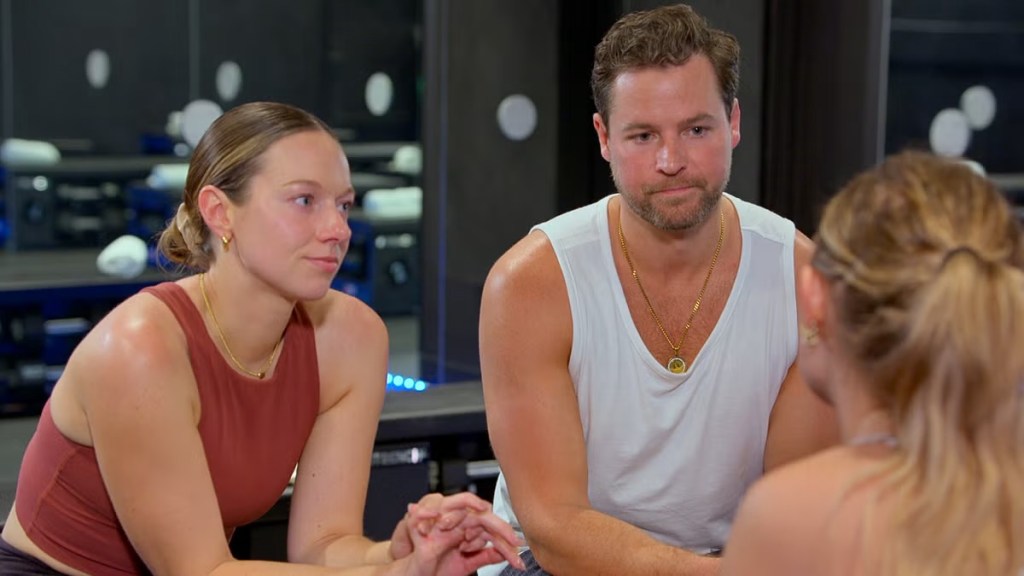
Season 8 of “Love Is Blind” graced our screens with the ever-dapper duo, Nick and Vanessa Lachey, guiding a new batch of hopeful romantics through the labyrinth of love—all set against the picturesque backdrop of Minneapolis. The show’s signature format remained intact: men and women dating without ever laying eyes on each other, building connections through the heart rather than the eyes. This season, however, offered a deeper dive into the contestants’ backgrounds, allowing viewers to witness the budding rapport among participants. While this added depth to the narrative, it occasionally felt like watching paint dry—necessary for context but a tad tedious at times.
Lauren and Dave: The Almost Love Story
Among the couples, Lauren O’Brien and David Bettenburg stood out as the duo that tugged at our heartstrings. Lauren’s raw and unfiltered emotions resonated with viewers, making her one of the most compelling figures this season. Their journey, however, hit a roadblock when revelations about Lauren’s past surfaced. David discovered that Lauren had been casually involved with someone else shortly before filming began. This revelation, combined with the ensuing gossip among friends and family, led David to call off the engagement.
Ben and Sara: A Political Divide
Sara Carton and Ben Mezzenga’s relationship was a rollercoaster of emotions, primarily driven by their clashing religious and political views. The reunion episode shed light on their tumultuous breakup, with Ben accused of “ghosting” Sara—a modern dating faux pas if there ever was one. Their story serves as a poignant reminder that while love may be blind, it’s certainly not deaf to political discord.
Madison: The Enigma
Madison Errichiello was the season’s enigma, oscillating between potential suitors like a pendulum in a grandfather clock. Her indecisiveness left viewers scratching their heads, wondering if she was genuinely interested in forming a connection or simply enjoying the attention. Her abrupt shifts in affection made it challenging for audiences to relate, casting her as the season’s wildcard.
Devin and Virginia: A Clash of Core Values
Devin Buckley and Virginia Miller’s relationship was a classic case of opposites attract—until they don’t. Their differing views on politics, religion, and finances proved insurmountable, leading to a breakup that surprised no one. Their journey underscores the importance of aligning core values in a relationship, especially when navigating the complexities of modern life.
Monica and Joey: Miscommunications and Mistrust
Monica Danús and Joey Leveille’s relationship was marred by miscommunications and a possible lack of chemistry. Despite their initial connection, these issues led to a breakup once they reached the altar. Their story highlights the critical role of trust and clear communication in building a lasting relationship.
Meg & Mason: The Express Train and the Gentleman
Ah, Meg and Mason—a couple that, at first glance, seemed like a rom-com waiting to happen, but in reality, felt more like a sitcom with a lot of overlapping dialogue. Let’s be real—Mason was one of the most genuine, down-to-earth guys of the season. He had that calm, steady energy that made you root for him. And then… there was Meg.
Meg, bless her heart, came across as the human equivalent of a high-speed train—unstoppable, unfiltered, and, at times, just a bit too much for a one-on-one conversation. It was almost as if Mason was playing a silent game of “how many words can I squeeze in before Meg takes off again?” And the answer was… not many.
That being said, their dynamic was oddly fascinating. While they weren’t the fairytale romance we usually expect from Love Is Blind, they were certainly entertaining. You’d think their personalities would be too mismatched to work, but somehow, they found a way to understand each other.
Now, did they make it to the altar? Nope. Did we expect them to? Also nope. But what was refreshing was that instead of a dramatic, tear-filled, reality TV-style breakup, they simply realized they were better off as best friends. And honestly, that might have been one of the most mature conclusions of the season. They walked away without any resentment, no dramatic accusations, just a solid friendship.
Conclusion: A Season of Love, Loss, and Lessons
Season 8 of “Love Is Blind” offered viewers a smorgasbord of romantic escapades, emotional upheavals, and the occasional existential crisis—all set against the charming backdrop of Minneapolis. While not all couples found their happily ever after, the season provided ample entertainment and a few poignant lessons on love, compatibility, and the challenges of forming connections in a complex world. For fans of the series, this season was a rollercoaster worth riding, reaffirming that while love may be blind, it’s also unpredictable, messy, and, above all, human.
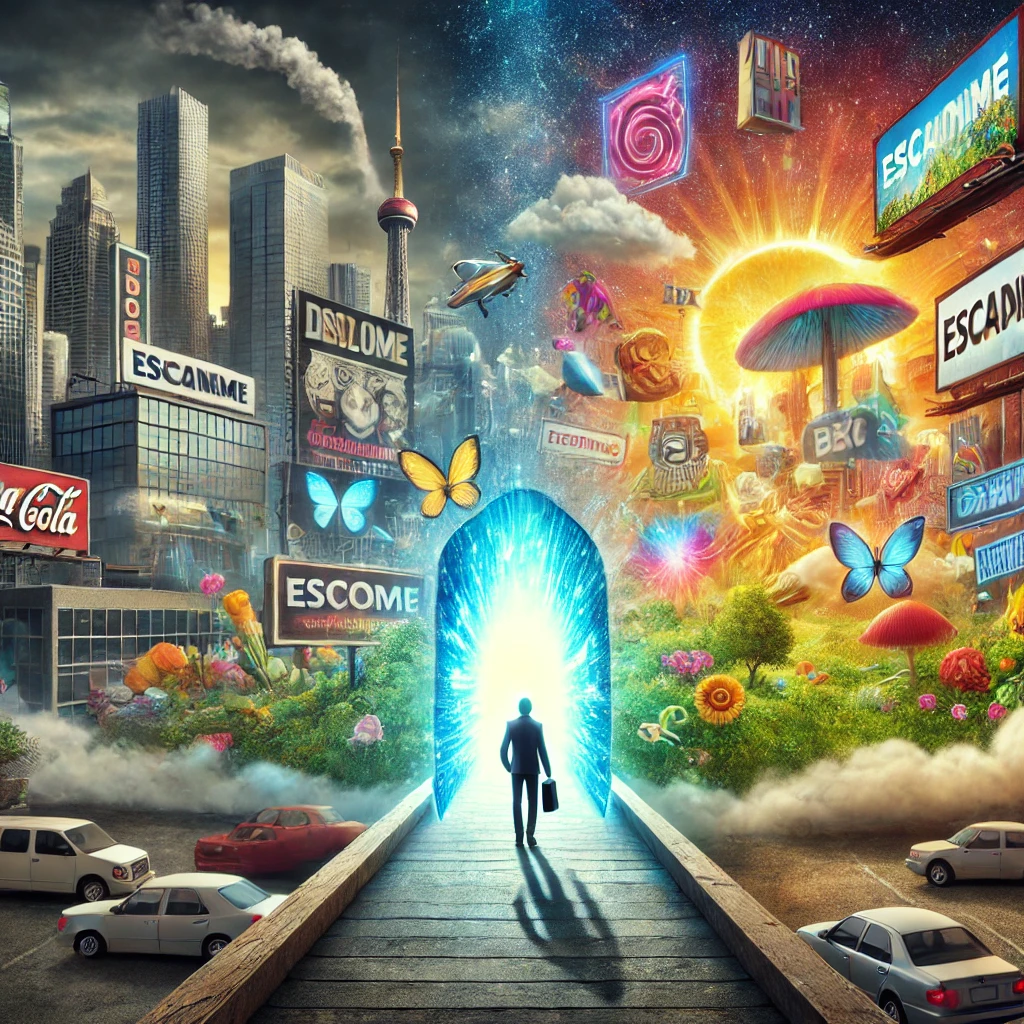
Ever felt the urge to dive into a world where deadlines don’t exist, and your boss is a talking dolphin named Gary? Welcome to the enchanting realm of escapism in marketing—a strategy that whisks consumers away from their daily grind into mesmerizing brand-crafted fantasies.
What is Escapism in Marketing?
Escapism in marketing is like handing consumers a golden ticket to Willy Wonka’s factory, minus the questionable child labor practices. It’s about creating immersive experiences that allow individuals to momentarily step away from reality and indulge in a captivating alternate universe. Brands achieve this through storytelling, immersive environments, and interactive content that transport consumers into a different world, offering a delightful respite from their everyday lives.
How is it Done?
Implementing escapism in marketing involves several key strategies:
1. Immersive Storytelling: Crafting narratives that pull at the heartstrings or tickle the funny bone, making consumers feel like they’re part of an epic saga or a hilarious sitcom.
2. Virtual and Augmented Reality: Using VR and AR technologies to create interactive experiences, allowing consumers to explore new worlds or see the real world with a fantastical twist.
3. Experiential Events: Hosting events that transform ordinary spaces into extraordinary realms, like turning a city park into a medieval fairground or a futuristic spaceport.
4. Fantasy-Themed Campaigns: Developing campaigns that incorporate elements of fantasy, science fiction, or surrealism to create a sense of wonder and escape.
Global Case Studies
1. Jacquemus’ Surreal World-Building: The fashion brand Jacquemus crafts visual narratives that feel like stepping into a high-fashion fever dream, creating entire worlds that captivate and transport consumers.
2. Valentino’s Fantastical Shows: Valentino has embraced escapism by producing elaborate, fantastical fashion shows that offer audiences a surreal experience, blending fashion with imaginative storytelling.
3. Burberry’s Surreal Campaigns: Burberry has successfully integrated surreal elements into their campaigns, generating significant engagement by offering consumers an escape from the ordinary.
4. Saint Laurent Productions: Saint Laurent has evolved into an entertainment studio, creating immersive narratives through cinematic storytelling, offering consumers a new form of escapism.
5. Miu Miu’s Women’s Tales: Miu Miu’s Women’s Tales series showcases short films that blend fashion with storytelling, creating immersive experiences that transport viewers into different narratives.
Indian Case Studies
1. Amul’s Topical Advertising: Amul’s witty and humorous advertisements provide a delightful escape from the mundane, often reflecting on current events with a playful twist.
2. Kingfisher’s ‘Kingfisher Calendar’: The annual Kingfisher Calendar transports viewers to exotic locations, offering a visual escape and associating the brand with luxury and leisure.
3. Zomato’s Quirky Campaigns: Zomato’s marketing campaigns often use humor and relatable content to create a fun and engaging experience, providing a momentary escape for consumers.
4. Fevicol’s Creative Advertisements: Fevicol’s ads are known for their creativity and humor, often depicting exaggerated scenarios that provide an amusing escape from reality.
5. Tata Tea’s ‘Jaago Re’ Campaign: This campaign used storytelling to address social issues, encouraging consumers to ‘wake up’ and engage, offering an escape from apathy and inspiring action.
Key Takeaways
• Emotional Connection: Escapism in marketing taps into consumers’ desires for adventure, relaxation, or fantasy, creating a strong emotional bond with the brand.
• Enhanced Engagement: Immersive and escapist campaigns often lead to higher consumer engagement, as they offer unique and memorable experiences.
• Differentiation: In a crowded market, escapist strategies can help brands stand out by offering something beyond the ordinary product or service.
Conclusion
In a world where reality can sometimes feel like a poorly written sitcom, escapism in marketing offers consumers a much-needed commercial break. By crafting experiences that transport individuals to fantastical realms or simply provide a chuckle, brands can create lasting impressions and foster deeper connections. So, next time you’re plotting your marketing strategy, consider adding a pinch of escapism—because who wouldn’t want to take a brief detour from reality, especially if it involves a talking dolphin named Gary?
If high fashion were a blockbuster movie, Anna Wintour would be the enigmatic director whose every move sets the tone for an entire genre. In this glitter-dusted epic, we explore how one woman transformed herself into a brand, how the Met Gala became the runway of cultural renaissance, and how Prada played the supporting role with unrivaled finesse.
A Brief Intro to the Queen of Cool
Anna Wintour—just saying her name conjures images of oversized sunglasses, impeccably coiffed hair, and an air of icy confidence that could melt glaciers. As the editor-in-chief of Vogue for decades, Anna didn’t just cover fashion—she redefined it. She’s the high priestess of style, the one who can make or break a trend with a single raised eyebrow. But beyond her sartorial prowess, Wintour has mastered the art of personal branding, turning her persona into a cultural phenomenon.
Her influence stretches far beyond the glossy pages of Vogue. With a career spanning several decades, Wintour has become synonymous with the Met Gala—a lavish annual fundraiser for the Metropolitan Museum of Art’s Costume Institute that is as much a spectacle of celebrity as it is a showcase of fashion innovation. And where does Prada come in? Ah, Prada—the label that embodies both timeless elegance and provocative modernity. Together, these three icons have not only defined an era of fashion but have also taught the world a masterclass in branding.
The Genesis: How Anna Wintour Became a Brand
Born to Be Iconic
Anna Wintour wasn’t born with a silver spoon in her mouth—she was born with a vision. From her early days as a fashion assistant to her meteoric rise at Vogue, Wintour has always had a knack for knowing what’s next. Her personal style, characterized by bold decisions and a no-nonsense attitude, quickly set her apart in a sea of mediocrity. It wasn’t just about the clothes; it was about the attitude, the confidence, and that unmistakable air of “I’ve got this” that she exuded effortlessly.
Her signature bob, those ever-present dark sunglasses, and an unyielding sense of purpose all contributed to an image that screamed, “I’m in charge here!” This wasn’t mere fashion—it was the birth of a personal brand that would influence generations.
The Rise of the ‘Wintour Brand’
In the fashion world, reputation is everything. And Wintour’s reputation was built on a foundation of high standards, impeccable taste, and an uncanny ability to spot trends before they even hit the runway. By curating a magazine that was both aspirational and accessible, she transformed Vogue into more than just a publication—it became a lifestyle.
Her influence wasn’t confined to editorial pages; it seeped into every corner of the industry. Designers, models, and even critics would cite “the Wintour effect” when their work was either celebrated or quietly shelved. With a single nod or a subtle critique, she could make or break a career. And this power, wielded with the finesse of a seasoned maestro, turned her into a living, breathing brand.
Prada: The Perfect Partner in Crime
Prada’s Evolution: From Traditional to Transcendent
Prada, a name that resonates with timeless sophistication, has long been a symbol of luxury and innovation. Founded in 1913, the brand has managed to remain relevant through a careful balance of tradition and bold experimentation. But in the 1990s, when the fashion landscape was becoming increasingly competitive, Prada took a daring turn. Under the creative vision of Miuccia Prada, the label embraced modernity without sacrificing its storied past. And where does Anna come into this picture? Enter stage left: a brand savant who recognized that Prada’s blend of heritage and avant-garde sensibilities was exactly the kind of magic that could elevate the entire industry.
A Match Made in Fashion Heaven
The partnership between Anna Wintour and Prada wasn’t a secret affair—it was the stuff of legend. Wintour, with her unerring eye for style, was one of the early champions of Prada’s bold new direction. She didn’t just feature Prada in Vogue; she made it a cornerstone of her aesthetic narrative. And in doing so, she helped catapult Prada from a well-respected label to a must-have status among the fashion elite.
Prada, in return, provided Wintour with a playground of innovation. Its fearless approach to design and its willingness to challenge the status quo perfectly complemented her own brand of unapologetic elegance. Together, they created a virtuous cycle: Wintour’s endorsement lent Prada an air of inevitability, while Prada’s groundbreaking collections ensured that Wintour’s magazine remained at the cutting edge of fashion.
The Met Gala: A Cultural Carnival of Couture
The Met Gala: More Than a Party, It’s a Phenomenon
If the Met Gala were a person, it would be that enigmatic socialite who wows you with stories of globetrotting adventures and exclusive soirées. Originally conceived as a fundraiser for the Costume Institute at the Metropolitan Museum of Art, the Met Gala has evolved into a veritable cultural phenomenon. It’s where art meets fashion, where high society rubs shoulders with creative geniuses, and where every guest becomes part of an elaborate performance art piece.
Anna Wintour’s fingerprints are all over the Met Gala’s transformation. By taking the reins of the event and infusing it with her signature style, she elevated it from a niche museum fundraiser to the pinnacle of the fashion calendar. Under her stewardship, the Gala has become synonymous with cutting-edge design, jaw-dropping celebrity appearances, and, of course, unforgettable themes that spark global conversations.
How Anna Transformed the Met Gala
Before Wintour’s involvement, the Met Gala was a well-regarded but somewhat staid affair. Enter Anna, and suddenly the event began to mirror her own vision of fashion: bold, innovative, and a little bit mischievous. She introduced themes that pushed the envelope—each one a testament to the transformative power of fashion as an art form.
Her influence ensured that the Gala wasn’t just about what people wore, but about the stories they told with their attire. Every theme was a narrative waiting to be interpreted, and every outfit a statement that could set the trend for the year to come. The Met Gala, under Wintour’s watchful eye, became a stage where the boundaries between art, fashion, and culture blurred in the most delightful way.
The Symbiotic Relationship: When Brands Collide
Wintour, Prada, and the Met Gala: A Triple Threat
At the heart of this story is a symbiotic relationship where each element—Anna Wintour, Prada, and the Met Gala—feeds into the other, creating an ecosystem of influence that is both dynamic and enduring.
• Anna Wintour provides the vision. Her discerning taste and unyielding standards set the tone for everything she touches.
• Prada offers the innovation. Its fearless approach to design and willingness to challenge tradition perfectly complements Wintour’s editorial direction.
• The Met Gala acts as the grand stage. It’s the culmination of all the creative energy, where ideas are not just showcased but celebrated on a global scale.
Together, they create a loop of mutual reinforcement: Wintour’s influence propels Prada to even greater heights, while Prada’s groundbreaking designs add credibility to Wintour’s editorial choices. In turn, the Met Gala amplifies the impact of both, serving as a living, breathing testament to what happens when visionary branding meets uncompromising creativity.
The Ripple Effect
This relationship is not just about mutual admiration; it’s about the ripple effect they create in the broader fashion ecosystem. When Wintour champions a designer, it’s as if she’s handing them a golden ticket to the upper echelons of style. When Prada pushes the envelope with a daring collection, it sets the stage for new trends that ripple through the industry. And when the Met Gala takes center stage, it becomes the cultural moment that defines the year.
This symbiotic dynamic has turned all three into veritable brands in their own right. Anna Wintour isn’t just an editor; she’s a brand. Prada isn’t just a fashion label; it’s an institution. And the Met Gala isn’t just an event; it’s a phenomenon that shapes how we think about art, fashion, and society.
Personal Branding Lessons: The Wintour Way
So, what can you learn from this dazzling trio about personal branding? If you’ve ever wanted to craft a brand that is as indelible as Anna Wintour’s, here are some key takeaways:
1. Define Your Unique Voice
Anna Wintour didn’t try to be everyone’s cup of tea. Instead, she embraced her distinctive style—a blend of razor-sharp wit, impeccable taste, and a no-nonsense attitude. Your brand should be a reflection of who you are at your core. Don’t shy away from the quirks and idiosyncrasies that make you unique; they are your greatest assets.
2. Be Unapologetically Bold
In an industry that often rewards conformity, Wintour’s willingness to take risks set her apart. Whether it was endorsing Prada’s avant-garde designs or reinventing the Met Gala, she wasn’t afraid to push boundaries. Personal branding is about standing out. Dare to be different, and don’t be afraid to challenge the status quo—even if it means ruffling a few feathers along the way.
3. Cultivate Consistency and Quality
One of the secrets to Wintour’s enduring success is her unwavering commitment to quality. Every decision she made—be it on the pages of Vogue or the guest list of the Met Gala—was guided by an unyielding standard of excellence. Consistency is key. Build your brand on a foundation of quality, and over time, your reputation will become synonymous with reliability and excellence.
4. Master the Art of Storytelling
At its core, fashion is about storytelling, and Anna Wintour is a master storyteller. Each issue of Vogue, every Prada collection, and each Met Gala theme tells a story that resonates on a personal level with its audience. Your brand should do the same. Craft narratives that connect with people, evoke emotions, and create memorable experiences. Storytelling isn’t just a marketing tool—it’s the heartbeat of a compelling brand.
5. Embrace Collaboration
No one builds an empire alone. Wintour’s journey was enriched by strategic collaborations—whether with innovative designers like Prada or with the creative minds behind the Met Gala. Surround yourself with people who complement your vision and can help amplify your brand. Collaboration opens doors to new ideas, fresh perspectives, and opportunities that you might never have encountered on your own.
6. Adapt and Evolve
The fashion industry is notoriously fickle, and staying relevant requires constant evolution. Wintour’s career is a testament to the power of adaptation—whether it was evolving Vogue to reflect changing times or reinventing the Met Gala to remain a cultural touchstone. Embrace change, be willing to reinvent yourself, and always stay ahead of the curve. A successful brand is one that evolves without losing its core identity.
7. Cultivate an Aura of Mystery
Part of what makes Anna Wintour so magnetic is the mystery that surrounds her. She’s not an open book—she’s a well-guarded secret, and that air of mystery only adds to her allure. While authenticity is crucial, a little mystery can go a long way in creating a sense of intrigue and desirability. Let your brand have its secrets, its quirks, and its little moments of enigma that keep people coming back for more.
The Cultural Impact: Beyond Fashion
While our discussion so far has revolved around branding, style, and runway theatrics, there’s a broader cultural narrative at play here. Anna Wintour, Prada, and the Met Gala have collectively redefined how we perceive luxury, art, and even societal norms.
Shaping Cultural Conversations
The Met Gala, under Wintour’s influence, has transcended its origins as a mere fundraising event to become a cultural milestone. Every year, its theme sparks debates, discussions, and, yes, even controversies. Whether it’s a bold reinterpretation of a historical era or a futuristic vision of what art can be, the Gala sets the tone for cultural conversations that resonate far beyond the confines of fashion. It’s a living, breathing commentary on the times—one that challenges us to think, feel, and question the world around us.
Redefining the Luxury Narrative
Luxury isn’t just about opulence and exclusivity; it’s about innovation, creativity, and the courage to be different. In a market saturated with tradition-bound institutions, Prada’s daring designs and Wintour’s editorial genius have redefined luxury as something that’s dynamic, progressive, and accessible to those who dare to dream big. This redefinition has paved the way for a new era of luxury—one that values creativity over conformity and storytelling over stodginess.
Inspiring Future Generations
For young creatives and aspiring professionals, Anna Wintour’s journey is nothing short of inspirational. Her ability to maintain an indomitable presence in an industry as fickle as fashion is a powerful lesson in perseverance, vision, and the art of reinvention. She shows us that success is not about fitting into a mold; it’s about breaking the mold and creating one that’s uniquely your own.
Key Takeaways: The Ultimate Guide to Personal Branding, Wintour-Style
As we wrap up our glitter-filled exploration of Anna Wintour, Prada, and the Met Gala, here are the key lessons that any aspiring brand (personal or professional) can take away from this illustrious trio:
1. Define Your Essence:
Know who you are and what you stand for. Your personal brand should be a clear reflection of your values, your vision, and your unique style.
2. Be Bold, Be Brave:
Don’t be afraid to take risks. Whether it’s experimenting with new ideas or challenging industry norms, boldness is the cornerstone of memorable branding.
3. Consistency is Queen:
Maintain high standards in everything you do. Consistency builds trust and ensures that your brand remains synonymous with quality and reliability.
4. Tell a Story:
People connect with narratives. Craft stories that resonate with your audience, evoke emotions, and turn your brand into an experience rather than just a product or persona.
5. Collaborate and Conquer:
Surround yourself with creative minds who elevate your vision. Collaboration can unlock new opportunities and help your brand reach heights you never imagined.
6. Stay Relevant:
The world is constantly evolving. Adapt to new trends, embrace change, and reinvent yourself while staying true to your core identity.
7. Keep ‘Em Guessing:
A touch of mystery can be incredibly alluring. Let your brand have layers—allow people to discover new facets of your personality and expertise over time.
8. Influence with Integrity:
True influence comes from authenticity. Use your platform to inspire, to challenge, and to lead with integrity, much like Anna Wintour has done throughout her career.
In Conclusion: The Unstoppable Force of Iconic Branding
The story of Anna Wintour, Prada, and the Met Gala is more than just a chronicle of high fashion—it’s a masterclass in how to build a brand that transcends time, trends, and traditional boundaries. It’s about forging an identity so compelling that it not only defines an era but also shapes the future.
Wintour’s career teaches us that personal branding isn’t about following the herd; it’s about carving out your own niche, standing tall in your uniqueness, and relentlessly pursuing excellence. Prada’s evolution reminds us that innovation and tradition can coexist beautifully if you dare to experiment. And the Met Gala? It shows that when you combine creativity with strategic vision, you can create an event so iconic that it becomes a cultural phenomenon.
For anyone looking to build a brand—whether it’s a personal brand, a startup, or an international luxury label—the lessons from this dynamic trio are clear: be unapologetically bold, maintain an unwavering commitment to quality, and above all, never be afraid to reinvent yourself.
So here’s to Anna Wintour, the indomitable queen of couture; to Prada, the ever-evolving beacon of luxury; and to the Met Gala, the dazzling spectacle that turns fashion into art. May their stories continue to inspire us to push boundaries, break molds, and create brands that are as unforgettable as a perfectly tailored suit on a red carpet.
Now go ahead and channel your inner Wintour—because in the end, life’s too short to blend in with the crowd.



















 Honest Reviews