
INTRODUCTION: MARKETING IS EASY… SAID NO ONE WHO WORKS IN MARKETING
Somewhere in a parallel universe, marketers are calm, consumers eagerly pay attention, CTRs exceed 2%, and strategists don’t have to explain (yet again) why “Everyone is not your audience.”
But here?
In this chaotic, overly connected, occasionally delusional reality?
Marketing is a glorious mess.
Brands scream.
Consumers scroll.
Agencies panic.
Clients panic louder.
And somewhere in between, someone says the words:
“Let’s target everyone. Why limit ourselves?”
And that, ladies and gentlemen, is precisely when a strategist spontaneously combusts.
If you’ve ever wondered why the marketing gods invented audience segmentation, it’s because they were tired of watching brands throw money at the entire universe like billionaires on a bender.
Audience segmentation exists to save your budget, your sanity, and your dignity.
It is the opposite of shouting.
It is whispering — to the right people — at the right time — about the right thing — in a way that doesn’t make them want to report you as spam.
This blog is your no-BS guide to segmentation.
Not the academic nonsense with Venn diagrams shaped like pastry.
Not the jargon-filled babble where “psychographic granularity” sounds like a skin disease.
No.
This is segmentation explained as if we’re in a pub, your client is three drinks in, and your job depends on making them understand why “males 18–60” is not a target audience but a police sketch.
Let’s begin.
1. WHAT THE HELL IS AUDIENCE SEGMENTATION (AND WHY SHOULD YOU CARE)?

Audience segmentation is simply this:
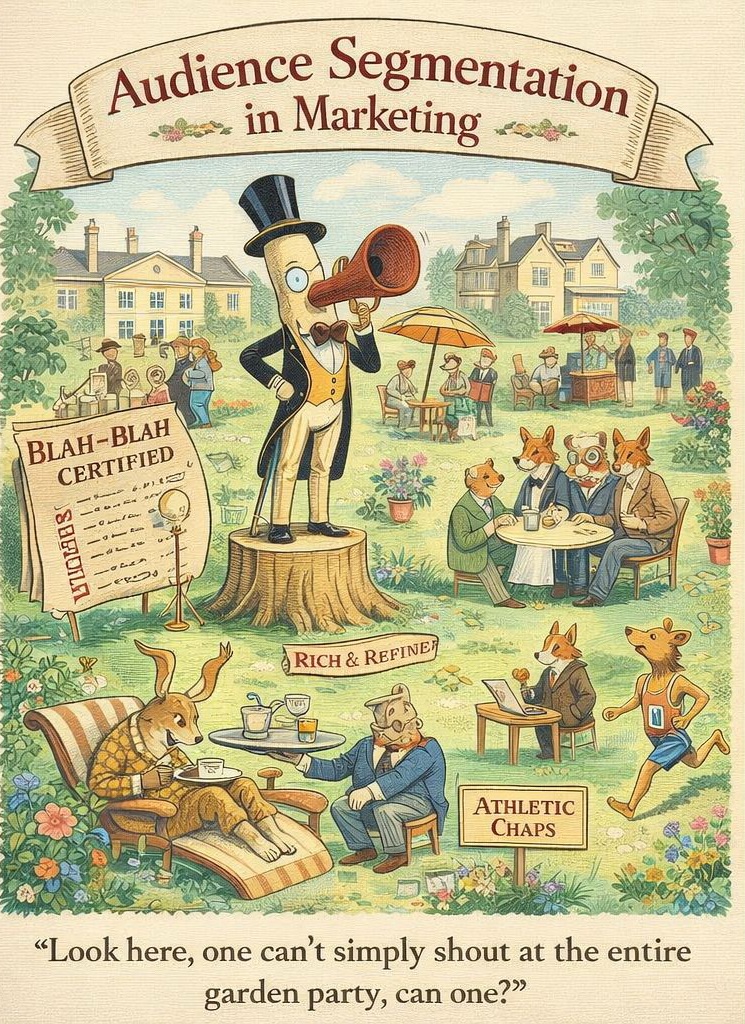
Dividing a crowd into smaller crowds so your message doesn’t sound like a megaphone having an identity crisis.
Imagine you walk into a stadium of 40,000 people and yell:
“HEY EVERYONE! DOES ANYONE WANT TO BUY A LUXURY DOG COAT?”
Most people will look at you the way they look at people who clap when a plane lands.
But if you walk into a park full of dog parents and politely say:
“Your dog is freezing. Stop pretending it’s fine.”
Boom.
Sales.
Segmentation is the difference between:
Marketing that feels personal and Marketing that feels like a mosquito buzzing in your ear at 2AM.
It matters because:
Not everyone wants your product. Not everyone needs your product. Not everyone should be allowed near your product.
And that’s beautiful!
It means you get to stop wasting time on people who don’t care — a concept shockingly radical for many marketers.
2. WHY MOST BRANDS SUCK AT SEGMENTATION
Let’s get one thing straight:
Marketers love the idea of segmentation.
Marketers hate the discipline of segmentation.
Here are the greatest hits of segmentation stupidity:
A. “Our audience is EVERYONE.”
If I had a rupee for every time a client said this, I could buy Cannes Lions with cash.
No product on Earth is for everyone.
Not tea.
Not smartphones.
Not oxygen — some people prefer chaos.
B. The “Age-Gender” Fallacy
“Females aged 24–40.”
Cool.
You’ve just described:
Rihanna
Greta Thunberg
Your yoga teacher
A woman plotting her ex’s downfall
And the lady who sells socks outside Andheri station
Do they want the same things?
No.
Do they behave the same way?
Absolutely not.
Will they buy the same product?
Only if you’re selling oxygen.
C. The “Income Bracket” Nonsense
“He earns 10–15 lakhs. He must be our customer.”
No, he might just be sad, lonely, confused, a gamer, a crypto bro, or saving for a 1BHK.
Income says nothing about what people want.
It only says what they can afford, not what they will spend on.
D. The Fantasy Persona
“Meet Rohan. He is 29, drinks artisanal coffee, loves sneakers, rescues puppies, runs half marathons and volunteers at orphanages on weekends.”
No, he doesn’t.
He’s fictional.
And if he did exist, he would be insufferable.
3. THE TRUTH ABOUT SEGMENTATION: IT’S NOT ABOUT DATA — IT’S ABOUT HUMAN BEHAVIOUR

Segmentation is fundamentally about why people do things, not just who they are.
Too many marketers obsess over demographics and forget:
People don’t buy products.
People buy better versions of themselves.
Segmentation is understanding that:
A 60-year-old who wants to feel young has more in common with A 30-year-old having an existential meltdown
…than two 30-year-olds who hate each other online.
Stop dividing people by age.
Start dividing them by motivation.
4. THE FOUR TYPES OF SEGMENTATION (EXPLAINED LIKE A HUMAN BEING)
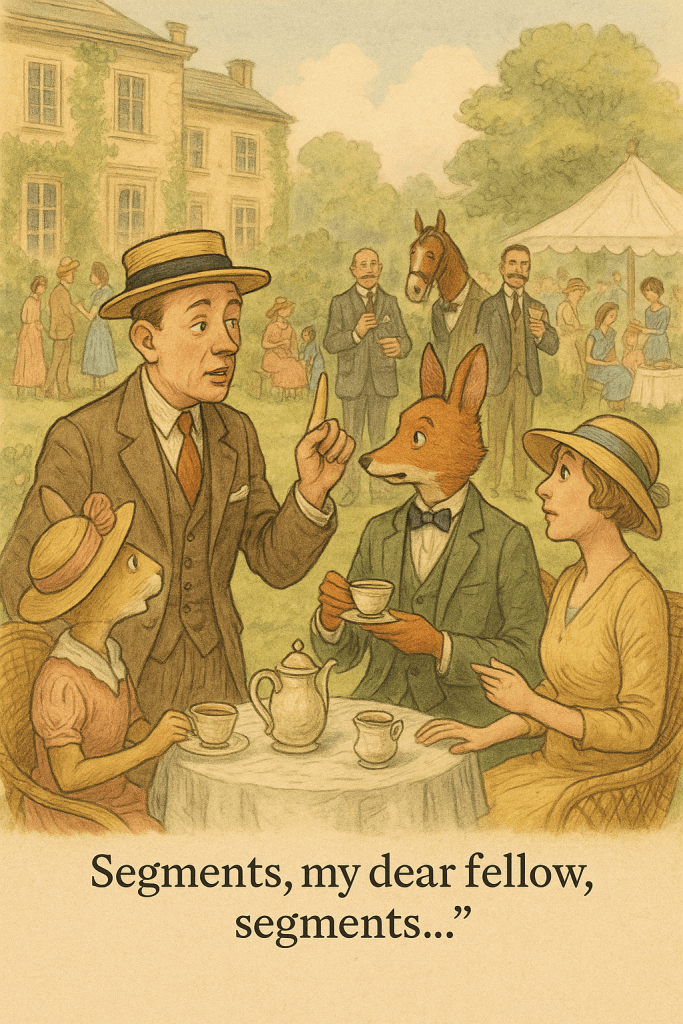
Yes, academically there are four kinds.
But let’s explain them in a way your cousin who sells insurance on WhatsApp would understand.
A. Demographic Segmentation
(“Who are they?”)
Age, gender, income, education, marital status, etc.
Useful, but basic.
Like plain dosa.
Functional, but no one gets excited about it.
B. Geographic Segmentation
(“Where do they live?”)
Different places = different behaviours.
People in Mumbai buy umbrellas.
People in Bengaluru buy patience.
People in Delhi buy air purifiers and forgiveness from society.
Geography matters.
C. Psychographic Segmentation
(“Why do they behave like this?”)
Attitudes
Beliefs
Values
Lifestyle
Fears
Dreams
Secrets
This is where segmentation grows up, starts reading philosophy, and becomes interesting.
This helps you understand:
Who wants convenience
Who wants status
Who wants validation
Who wants to escape their family
Useful for many categories, especially alcohol.
D. Behavioural Segmentation
(“What do they do?”)
This includes:
Purchase frequency
Loyalty
Browsing habits
Reactions to offers
Whether they abandon carts like they abandon relationships
This one is gold.
Because people lie about who they are.
They never lie about what they do.
5. THE GOLDEN RULE OF SEGMENTATION: PEOPLE DON’T THINK ABOUT YOUR BRAND UNLESS THEY’RE PAID TO
Segmentation is simply figuring out:
Whose life you can make better
By how much
And whether they’ll give a damn
You’re not segmenting people.
You’re segmenting problems you can solve.
6. THE SEGMENTATION PYRAMID OF REALITY

There are three levels of segmentation maturity:
Level 1: The Amateur Phase (“Our audience is millennials”)
Congratulations.
You’ve identified 2.3 billion people.
Good luck.
Level 2: The Enlightened Phase (“Our audience is new parents in tier-1 cities who feel guilty about not spending enough time with their kids.”)
Now we’re cooking.
You’ve identified:
A life stage
A geography
A pain point
This is segmentation with a pulse.
Level 3: The Jedi Phase (“Parents who believe ‘quality time’ matters more than ‘quantity time’ and want guilt-free shortcuts.”)
Here you have:
A belief
A behaviour
A motivation
An emotional need
This is segmentation that sells.
7. HOW TO CREATE A SEGMENT THAT ACTUALLY MAKES SENSE
Follow this five-step process:
Step 1: Identify the real problem
Not the problem you want to solve.
The problem they actually have.
People don’t want financial planning.
They want to stop feeling like their bank account is a disappointment.
Step 2: Look for emotional triggers
Every purchase has an emotional trigger:
Fear Pride Convenience Status Love Laziness (a very underrated motivator)
Step 3: Group people by shared motivations
Examples:
“People who want to look healthier than they actually are.
People who shop online at 2AM because life is hard.”
People who pretend they know wine but don’t.”
These are actual usable segments.
Step 4: Check whether this segment has money
Without money, a segment is called a “community group,” not a market.
Step 5: Tailor messaging like you’re writing a text, not a brochure
Talk to them like they’re human.
Not like a marketing assignment.
No one says:
“I want to enhance experiential transformation.”
They say:
“I want to feel something again.”
8. THE SEGMENTATION MISTAKES EVERY BRAND SHOULD AVOID (BUT WON’T)
Mistake #1: Making segments too big
If your segment includes “people who breathe,” start over.
Mistake #2: Making segments too small
If your segment consists of 14 people in Bandra who like kayaking, maybe relax.
Mistake #3: Creating segments you can’t reach
If they live in a forest, don’t advertise on Instagram.
Mistake #4: Segmentation ≠ stereotyping
Not every woman in her 40s drinks wine and does yoga.
Some drink whiskey and scream into the void.
Mistake #5: Using segmentation as a crutch for bad ideas
Segmentation won’t save boring advertising.
Creativity will.
9. EXAMPLES OF BRILLIANT SEGMENTATION (FROM BRANDS THAT KNOW WHAT THEY’RE DOING)
Apple
Segments by mindset, not demographics.
Targets people who want to feel creative, even if the most creative thing they’ve done this month is rearrange apps.
Nike
Segments by motivation.
“You’re an athlete if you have a body.”
Boom — inclusive, inspirational, segmentation magic.
Old Spice
Segments by identity aspiration.
Targets men who want to smell like confidence even if their greatest accomplishment is ordering food on time.
10. WHY SEGMENTATION MAKES YOUR BRAND ACTUALLY LIKEABLE
When you talk to fewer people, you talk better.
When you talk better, people listen.
When people listen, they buy.
When they buy, your brand manager stops hyperventilating.
It’s a win-win.
Segmentation humanizes your brand.
It makes your message relevant.
It stops you from sounding like corporates who write sentences like:
“Our solution leverages agile synergies to maximize transformational value.”
If your brand ever writes something like that… seek help.
11. THE “SEGMENT OF ONE” MYTH (AND WHY PERSONALISATION ISN’T WHAT YOU THINK IT IS)
Some tech bros will tell you:
“The future is the Segment of One.”
No.
That’s called “stalking.”
Personalisation is good until it becomes creepy.
If your ad says:
“Hi Rajiv from Powai, how is your dandruff today?”
That’s not segmentation.
That’s a restraining order waiting to happen.
12. HOW TO USE SEGMENTATION IN ADS THAT ACTUALLY PERFORM
A. Speak the language of the segment
A Gen-Z ad that sounds like it’s been written by a board member will die a painful digital death.
B. Show them you understand their truth
A mother doesn’t want a vacuum cleaner.
She wants a home that doesn’t look like a tornado interned there.
C. Reflect their aspirations, not your QR codes
People buy identity.
Not click-through rates.
D. Make them feel seen
The greatest compliment any ad can receive is:
“This is so me.”
13. THE FUTURE OF SEGMENTATION (IF WE DON’T RUIN IT)
Segmentation won’t disappear.
It will evolve.
Expect:
AI that identifies micro-behaviours
Predictive behavioural clusters
Segments based on emotional states
Ads that adapt to your mood (terrifying, but here we are)
But no matter how advanced tech becomes…
Segmentation will always be human at its core.
Because marketing is not about impressions.
It’s about impact.
And impact happens when someone feels understood.
14. THE FINAL RANT (YOU KNEW THIS WAS COMING)
If brands spent half as much time understanding people as they do making 200-slide PowerPoints about “user personas,” the world would be full of better advertising.
Segmentation is not a formula.
It’s not a framework.
It’s not a matrix invented by someone who wears too many pastel shirts.
Segmentation is empathy with structure.
It’s psychology with purpose.
It’s saying:
“I see you.
I get you.
Here’s something that makes your life a little better.”
And if you can do that?
You won’t need to shout at the entire universe.
Your audience will come find you.
CONCLUSION: SEGMENTATION ISN’T ABOUT DIVIDING PEOPLE — IT’S ABOUT CONNECTING BETTER
Good segmentation doesn’t shrink your audience.
It sharpens it.
It doesn’t limit your reach.
It increases your relevance.
It doesn’t kill creativity.
It turbocharges it.
Because when you know exactly who you’re talking to…
you finally stop sounding like a brand talking to “targets”
and start sounding like a human talking to humans.
And that is how segmentation doesn’t just improve marketing —
it saves it!
 Honest Reviews